Unlock Success with JEE Previous Year Papers: Your Guide to Using Them Effectively
Published on August 25, 2026 by Chetna singh
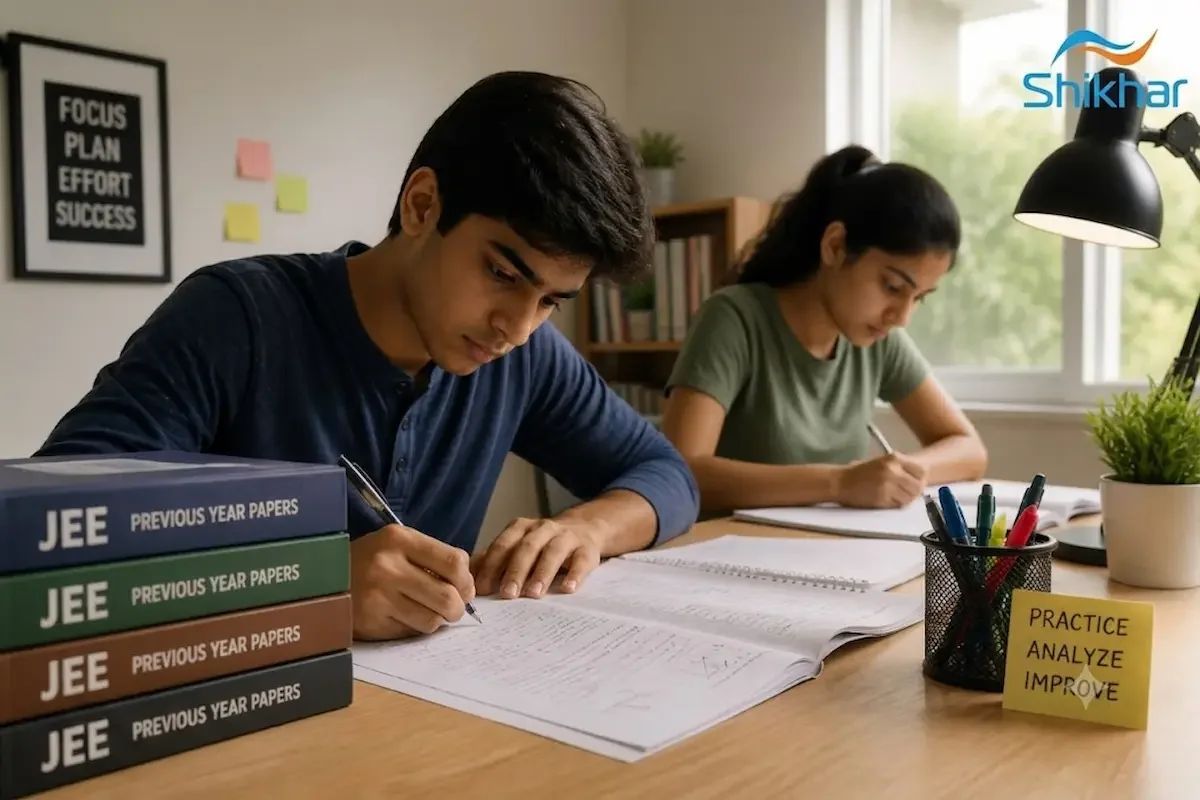
Unlock Success with JEE Previous Year Papers: Your Guide to Using Them Effectively
A huge number of Indian pupils are going through the JEE exam as a vital stage in their educational career right now. The stress from the competitive nature of this examination is huge, and thousands of students all over the country are trying to get admitted into the top 20 engineering colleges by the same examination of JEE only!
In such a scenario, students can't just rely on textbooks alone. The candidates who have really succeeded have a better understanding of the truth. These JEE previous year papers not only are a part of the exam preparation but also a roadmap to exam success. These materials provide one of the easiest ways of analyzing the structure and understanding the nature of the examination besides just learning or memorizing things.
What Makes JEE Previous Year Papers Indispensable for Your Preparation?
The use of these old question papers is definitely the biggest trick to make a quick transition from studying to applying your knowledge to answering exam questions correctly.
These papers will test not only your memory but also your speed. You have time to think, but that does not mean you have to memorize. You should learn to write well. Besides the memory, these papers also make your mind sharp as you have to tackle some complicated problems under time limit.
There is an additional bonus when you solve JEE advanced previous year question papers and JEE main previous year question papers. These papers show you what the real questions are like and what is being tested. So, solving these papers allows you to become familiar with what is expected.
Also, they give you a good insight into how marks are allocated. Once you are aware of these details, you are going to be very confident of giving a good solution to the paper. As these papers are in tune with the pattern of previous years, they will help you prepare to face the same on the actual exam day!
One of the greatest benefits offered by these solved papers under the condition of time limit is the recreation of the exam-like scenario of tension and time. It is in fact the best preparation for building endurance for such tests, reducing anxiety, and learning clock-watching. It is ultimately the factor that leads to the increase of confidence, transforming the candidate from a very stressed candidate to an efficient candidate.
How to Use Past Papers Effectively Without Feeling Overwhelmed?
The process of using past papers is basically of two parts. And do not be lured into thinking of solving hundreds of papers at the end of your preparation. Rather, you should plan and integrate these in a structured manner through the whole period of your preparation!
The first part or the learning stage consists of using JEE previous year papers at the very beginning of the preparations without any time constraint. What you want is not speed but understanding. Take as much time as you need. The idea here is to become comfortable with the type and quality of questions being asked in such a big competitive exam.
The second stage is the performance stage. After getting confident, you should try to solve question papers in strict exam environments. It means using a timer, working in a quiet room, and writing the full paper in a single sitting. This kind of practice will help you to learn time management and coping skills. The shift from a non-timed to a timed approach is one of the main secrets for the efficient preparation of the exam.
What is the 1-3-7 Rule for Revision and How Does It Help?
The 1-3-7 rule is a potent spaced repetition system that allows you to remember the materials for a long time, in particular, if you apply it together with previous year JEE papers. This technique works by setting up a simple pattern which allows material to pass from short to long-term memory. The rule explains in a clear, step-by-step way, for example, that if you master a topic and/or have corrected a mistake, you should review:
- Day 1: The same day you studied the material.
- Day 3: You should go through the material once again 3 days later.
- Day 7: You have only one more review planned for after a week.
If you are a candidate for JEE mains and you use the 1-3-7 rule together with JEE main previous year question paper solving, you make a kind of mental reinforcement of any new topic or any error you find yourself in.
How Does the 2-3-5-7 Method of Revision Complement Your Practice?
The 2-3-5-7 rule is in fact a much more elaborated, sophisticated version of the concept of spaced repetition. With this technique, you get a slightly longer time before the next repetition of learning, which can also be great for a wide coverage of a topic in the revision.
The following is the case of this revision plan:
- Day 2: After you've finished the first review, that's the day you have the first recall of learning.
- Day 3: The date you do a second review of learning.
- Day 5: Your third recall of a topic comes at around the 5th day.
- Day 7: This is the final day when you have reviewed the learning material for the 4th time.
Once you realize that you have weak spots, you can use the 2-3-5-7 review approach to help you in working up your weaknesses. Such an organization is helpful enough to be able to recall your previous year paper's content when preparing for the next year paper a month later by making some reference to the previous year paper.
Why Analyzing Mistakes in JEE Papers Is More Important Than Getting the Right Answer
The core of learning lies in your mistakes, not just getting the right answer. Students frequently make the error of only checking their paper's marks. However, learning comes mainly from thoroughly investigating the results before a paper.
You should be able to do some thorough analysis of your errors to figure out why you make that type of mistake. Not just the right option, but when it is time to check your answers against solutions, you need to look at the entire solution to be able to identify the difference between your own method and what you have done versus the method that the examiner expects.
You maybe would have chosen the correct one but by an elaborate and time-consuming method. In the JEE, you would not have the luxury of choosing a time-consuming method. Your objective is to get an idea about the shortest way of doing the problem so that, in other words, it gets you ready for the actual exam.
The kind of thorough analysis done will not only enhance the quality of preparation but also help a student figure out the strategy of an exam. You will begin to see the pattern in your JEE advanced previous year question paper — for example, you will realize you always get a certain type of question in physics wrong, or a certain concept in chemistry you always read wrong. If you deal with the problem one by one like this, you are not just learning a certain topic — you are building your own customized strategy for your own weakness, which is what the best students constantly do.
How Can You Use Mistakes to Diagnose Your Weaknesses?
Diagnosing weaknesses is a process. Once you're completed with a previous year paper, check the answers, and use this logical step-by-step breakdown to improve your errors.
1. First, understand which type of mistake you commit:
- (i) Conceptual (lack of understanding of the concept)
- (ii) Formula mistake (applied the wrong formula)
- (iii) Silly mistake (misreading the problem)
Once you know the source, correct it. For instance, a series of calculation mistakes in a physics JEE previous year paper might show up in which area you need to work upon to do more numericals.
2. Next, build a 'Mistake Log'. For every mistake that you make, record the topic, the mistake, the correction, and exactly where you went wrong. This becomes your 'crib sheet' that you can take in with you to your exam during the final weeks of preparation and use this to make sure you don't make this mistake again.
3. Finally, once you have truly learned from the mistake and gap in your knowledge, do 3-4 similar questions from another JEE main previous year question paper or a reference book on the same topic. This will make sure you have really learned and filled the gap in your knowledge. Doing 3-4 similar questions after certain practice, mistake learning, and correction is the best way to improve your score. That is ten times more effective than doing a dozen papers blindly.
A Structured 6-Step Framework for Mastering JEE Previous Year Papers
Follow this proven 6-step setup to assure that you use your practice to its fullest. It will elevate you from a passive solver to an active analyst.
1. Resource Gathering and Planning: Collect a set of JEE previous year papers for 10-15 odd years. Group them year-wise. Plan week-wise on which of the papers you will solve. Don't try to solve all of them. Spend some time figuring out a sequence.
2. Simulated Timed Attempt: Select a JEE main previous year question paper. Keep a timer or alarm on for the same duration as the exam (3 hours). Sit in a secluded room with no distraction. This attempts to simulate the actual exam environment, helping develop your endurance and concentration.
3. Post-Paper Review: When the time on the timer expires, don't check the answers right away. Take a 15-minute break. Afterwards, slowly go through your answers with the help of the official answer key. Record your score and begin to work out the questions you got wrong/uncertain about.
4. Detailed Mistake Analysis: Check every incorrect answer. Not just the correct answer. Pen down the correct approach. Classify the mistake as concept error, calculation error, or a careless mistake. Record it in the Mistake Log.
5. Concept Gap Filling: If your mistake indicates a concept gap, review your textbooks or notes. Review the whole chapter instead of just the incorrect concept. Do a few more practice problems to get comfortable.
6. Final Review and Strategy Refinement: After 3-4 days, again solve the same JEE advanced previous year question paper, only the questions which you could not solve. If you can solve these questions now, that topic is locked. This step also helps you to refine your working strategy, for example which section to start first, etc.