JEE Study Material 2027: The Ultimate Guide to Books, Free Resources & Strategy
Published on July 1, 2026 by Parul Sharan
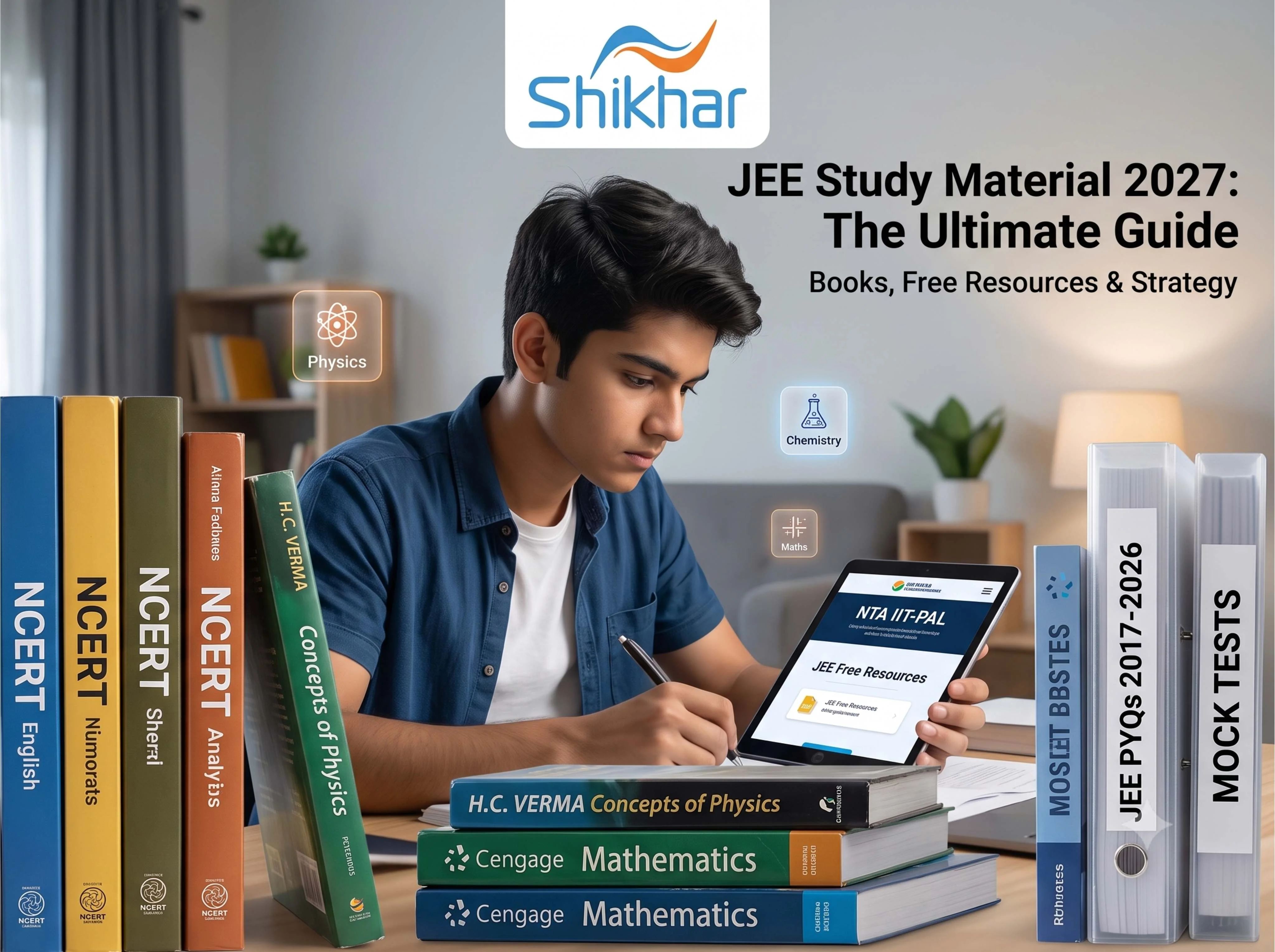
JEE Study Material 2027: The Ultimate Guide to Books, Free Resources & Strategy
Every year, more than 9-10 lakh students participate in JEE Main, but only the top 2.5 lakh make it to JEE Advanced. Often, the only factor between a dream running on time or getting an IIT seat is the quality of your JEE study material.
In the 2027 session, the huge pile of books, PDFs, and coaching modules can cause "resource overload." This guide eliminates the distractions and offers you a clear, subject-wise plan with NCERT, topper-recommended books, and free government resources to help you get maximum rank.
What is the Best Study Material for JEE? (The Core Combo)
A major mistake which most candidates make is that they prefer to find a single "best" book, whereas it is a fact that the best JEE Study Material is just a well-planned mixture of three levels: basic theory, advanced problem-solving, and practice with the exam pattern. According to IIT Kanpur's SATHEE initiative, NCERT is the main, but reference books are "very much recommended" for JEE-level questions.
Layer 1: The NCERT Bible.
For Inorganic Chemistry and basic Physics/Maths theory, the NCERT Books are unalterable. If you do not know these textbooks very well, advanced books will be useless to you.
Layer 2: Standard Reference Books.
H.C. Verma for Physics and Cengage for Mathematics are some books that help you in understanding complex, multi-concept problems of JEE by going a step further than basic theory.
Layer 3: PYQs & Mock Tests.
Working on Previous Year Question Papers (PYQs) is one way to get familiar with the "language" of the exam and its regular patterns.
To the point:
By mastering this three-layer combo, you will not just be studying harder, but also smarter, focusing directly on the skills needed for both JEE Main and Advanced.
Why NCERT Textbooks Are the Non-Negotiable Foundation
Before starting with reference books, a student should be very clear with the NCERT Books curriculum. The National Testing Agency (NTA) makes the JEE Main syllabus mainly from the NCERT and approx. 40-50% of the questions in the Chemistry part can be solved directly from the NCERT lines.
The Role of NCERT for JEE Main vs. Advanced
You need to revise thoroughly and improve your speed in the NCERT for JEE Main. The theory is strong, but the level and types of numericals, especially for Physics, are inadequate. For JEE Advanced, the conceptual understanding needs to be at a much deeper level. While NCERT will tell you "what, " reference books will tell you "how."
- Physics: NCERT should be referred to for a good understanding of derivations, but the transition to H.C. Verma is necessary for getting a hold of applications.
- Chemistry: NCERT is the final authority for Inorganic Chemistry. Physical and Organic need to refer to some more texts.
- Mathematics: The NCERT only contains the basics. For JEE Advanced, one has to get hold of difficult problems by turning to additional books.
Subject-Wise Guide: Best Books for JEE Physics, Chemistry, and Maths
Becoming an IITian calls for you to come up with a subject-wise selection strategy instead of a one-size-fits-all method. Triple-A rankers and leading platforms like Shikhar Classes, Vedantu and Unacademy have suggested the following list of JEE Study Material books, which truly are a child of the perfect study material fairy.
Best Chemistry Book for JEE (Physical, Organic, Inorganic)
The chemistry section is the highest-scoring with the right resources.
- Physical Chemistry: Theory - NCERT, then go to O.P. Tandon or R.C. Mukherjee for a wide variety of numericals.
- Organic Chemistry: NCERT is a must. For mechanisms in-depth, Morrison & Boyd or M.S. Chouhan is used.
- Inorganic Chemistry: NCERT is the Holy Grail. Please don't skip even a single line. If what you get is not enough in your opinion, refer to J.D. Lee for a more advanced level.
Books for JEE Advanced (Physics & Maths Focus)
After getting JEE Advanced, you must understand that the difficulty level will rise drastically. That is the time when you must have the resources that help you develop your analytical thinking.
- Physics: H.C. Verma (Concepts of Physics), a complete set can help you a lot in building the intuition that is required. After that, get the practice of I.E. Irodov (Problems in General Physics) and Krotov-level problems for Advanced-level problem-solving.
- Mathematics: Go for the Cengage Series (Calculus, Algebra, etc.) extensively. For Differential Calculus, you can also refer to Arihant's book by Amit M. Agarwal. For more advanced trigonometry, S.L. Loney is a classic.
JEE Free Study Material: Top Online Resources & Archives
You don't have to spend crores to get quality material. A lot of high-authority, government-supported, and community-led platforms are offering JEE Free Study Material which are on par with expensive coaching modules in quality.
Official NTA & IIT Resources
National Testing Agency (NTA) presents IIT-PAL (IIT Professor Assisted Learning) video lectures, which have been created by IIT professors. These explain complex concepts in Physics, Chemistry, and Maths. And best of all is their availability, totally free.
Telegram, Reddit & Archives (Use with Caution)
Platforms like JEE Archive hold a complete digital library, inclusive of previous year question papers, coaching material (Allen, Resonance), and test series.
- Reddit (r/JEENEETards): It's a great place to hear people's opinions about specific PDFs.
- Telegram: There are a lot of channels that give IIT JEE Books PDF Google Drive links. Please be careful that you are downloading the latest syllabus edition (2027).
- Self-Studys: These are the ones who have created updated notes and chapter-wise PDFs mainly for the 2027 session.
Strategic Study Plan: Integrating Coaching Material with Standard Books
Suppose you are a student of a coaching institute or accessing free JEE Main Study Material online, then the question arises: how do you go about balancing it with standard books? You will get confused by the use of too many resources.
- Benefit of Coaching Modules for Daily Practice (DPPs): Coaching modules have been constructed in such a way as to sharpen your speed and accuracy. Use them to solve 20-30 problems everyday for keeping your problem-solving endurance at an optimum level.
- Target Concept Depth with Standard Books: There will be times when you will come across a challenge in your module (e.g. "Friction" in Physics). Trying to memorise the module solution alone is not a good idea. Rather, go back to H.C. Verma for conceptual understanding.
- The "Master One Book" Rule: According to toppers, you should concentrate on mastering one particular book per subject instead of skimming five. For instance, fully master H.C. Verma before moving on to Irodov. Excess of resources kills efficiency.
Quick Glance: The Final Checklist for JEE Study Material 2027
Next time, when you are ready for study, make sure you have your toolkit checked with the following items. This is a quick summary of choosing the right resources.
- NCERT Textbooks (Class 11 & 12): 100% done for all subjects, especially for Inorganic Chemistry.
- Standard Reference Book (One per subject): H.C. Verma (Physics), O.P. Tandon/Morrison (Chemistry), Cengage/Arihant (Maths).
- Previous Year Papers (PYQs): Last 10 years of JEE Main & Advanced (PDFs available on NTA site or JEE Archive).
- Formula Handbook: A quick revision booklet (like Allen's handbook) for last-minute formula recall.
- Mock Test Series: Take full-length timed tests to build speed.
Conclusion
IIT JEE is a matter of disciplined execution using the right tools rather than a superior intellect. Your evolution from a school student to an IITian is moving from passive reading to active learning (writing notes, solving PYQs, and revising using mind maps). Start from your NCERTs, build your concepts with the standard books mentioned above, and keep testing using free resources such as NTA's IIT-PAL lectures and JEE Archive. Follow this guide, do not suffer resource overload, and you will have the greatest chance of success in 2027.
Frequently Asked Questions (FAQs) on JEE Preparation
How many marks is 70 in JEE?
The difficulty level of the session determines this, but 70 marks in JEE Main, according to the general graph, will be equivalent to a percentile of approximately 85-90. This score or rank will mostly not be sufficient for qualifying JEE Advanced (which generally requires >90 percentile) but it may land you in some state-level engineering exams.
Can I get IIT with a 30,000 rank?
As a rule of thumb, a rank of 30,000 in JEE Advanced is far from being sufficient to secure core CSE or Electrical branches in the well-established old IITs. In contrast, you may be able to enroll in a lesser-known IIT (for example, IIT Palakkad, IIT Tirupati) for branches like Mining, Civil, or Metallurgy, or even the BS program in Economics.