JEE Main vs JEE Advanced: Complete Comparison Guide for IIT and NIT Aspirants
Published on July 11, 2026 by Parul Sharan
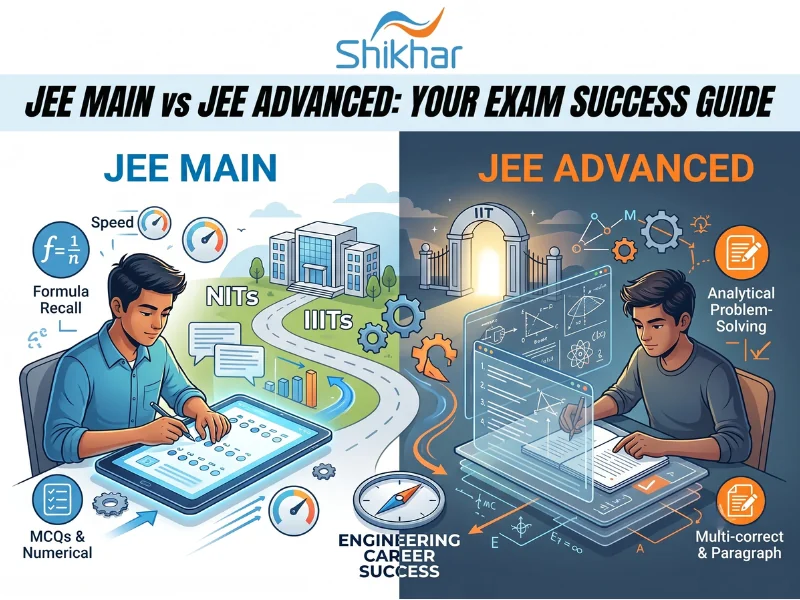
JEE Main vs JEE Advanced: Complete Comparison Guide for IIT and NIT Aspirants
Every year, more than 1.5 million students in India take the Joint Entrance Examination with the hope of getting admission to the top engineering institutes in India. Despite this, many students and their parents are still unclear about the key differences between JEE Main vs JEE Advanced.
It is very important to understand this difference because your preparation, target schools, and even your future will be very different according to which exam you decide to focus on. Although both exams are based on Physics, Chemistry, and Mathematics of Classes 11 and 12, they serve very different purposes and have different levels of difficulty and also unlock different opportunities.
What Are the Key Differences Between JEE Main and JEE Advanced?
The main difference is that JEE Main and JEE Advanced are two different stages of an engineering admission process. JEE Main is the entrance test for engineering colleges in India, whereas JEE Advanced is the entrance test to IITs only.
You can think of JEE Main as a basic screening test, and JEE Advanced as the final exam for top students only. The student must pass JEE Main and be in the top 2,50,000 rank list to be eligible for JEE Advanced.
This table gives an overview of the major differences between JEE Main and JEE Advanced.
By knowing these basic differences, you will be able to set a realistic goal for yourself. If you want to go to NIT or IIIT, just preparing for JEE Main will be enough for you. But if you want to get a seat in IIT, then you will have to prepare well for both exams with more focus on the problem-solving abilities for Advanced.
JEE Main vs JEE Advanced Syllabus: What's the Real Difference?
One of the biggest misunderstandings among JEE aspirants is that the syllabus for JEE Main and JEE Advanced is completely different. Actually, the topics are almost identical - both JEE Main and JEE Advanced take their questions from the NCERT syllabus for Physics, Chemistry, and Mathematics of Classes 11 and 12.
The real difference is in how the questions are posed and how deeply you need to know the topic.
Syllabus Overlap and Depth Variation
JEE Main questions are direct and can be solved mostly by using formulas. Once you have memorized formulas, even for difficult chapters like Kinematics, Thermodynamics, or Organic Chemistry, you will be able to solve most problems at the Main level without much effort. In contrast, JEE Advanced tests the same syllabus but with a much higher level of difficulty.
A question in Advanced can require you to use concepts from Mechanics, Electrodynamics, and Calculus all together. This multi-concept question is what makes Advanced a really tough exam.
Topics That Carry More Weight in JEE Advanced
Besides this, there are some topics which need special attention for the Advanced: the concepts of Inverse Trigonometry and Co-factors, Rotational Mechanics, Electrostatics and Magnetism, and Organic Chemistry Reaction Mechanism are areas where the Advanced questions are really tough and conceptual in nature.
For those who want to prepare for JEE Advanced, fidelity to the NCERT curriculum is non-negotiable, followed by practice of application-based problems suited for Advanced level as recommended by Shikhar Classes.
JEE Mains vs JEE Advanced Difficulty: Why Is Advanced Considered Tougher?
Nearly all coaching experts, toppers, and analysts agree that JEE Advanced is Much harder than JEE Main. What makes it tougher?
It is mainly about the pattern of questions, their unpredictability, and the type of thinking that is required rather than the topics being tested.
Question Pattern Complexity
The number of questions in JEE Main is usually fixed at 75 and the pattern is very straight forward. Most of the questions are multiple-choice questions having only one correct answer, plus a few numerical value questions.
JEE Advanced though has around 54 to 72 questions of various types including:
- Multiple-correct options: There may be more than one correct answer and you will have to choose all that are correct.
- Matching list questions: You will have to match two or three columns based on their logical relationship.
- Paragraph-based comprehensions: There could be a passage with 3 to 4 related questions where the answers to the earlier ones would help in solving the later ones.
- Partial marking schemes: You may get partial credit for incomplete but partially correct answers, which makes the evaluation a little complicated.
Conceptual Depth vs Rote Learning
The JEE Main examination largely depends on a student's ability to memorize and time management skills for formula application under exam conditions. JEE Advanced however, will make you prove that you have understood the concepts through and through.
Is a Particular Shift of JEE Main Harder?
Recently, there have been many queries about whether JEE Main is harder or easier from shift to shift, most of these questions have come up as a concern for JEE Main Shift 2 vs Shift 1. To keep the whole process transparent and fair for the candidates appearing for different shifts, NTA implements normalization (percentile scoring process).
However, many people point out that in the very nature of these two exams, any shift of JEE Advanced always remains tougher than any shift of JEE Main. So the panic about the shifts in the Main phase is misplaced as the real challenge comes when you transition from Main to Advanced.
Eligibility and Attempt Limits: Who Can Appear for Which Exam?
Knowing the eligibility conditions is very important for the students for planning their exam preparation strategy and if needed, to avoid any last-minute shock of being barred from sitting for the exam. Many are under the wrong impression that they can directly appear for JEE Advanced.
JEE Main Eligibility
Any student meeting the qualification criteria of having passed or appearing in Class 12 (or equivalent) with Physics, Chemistry, and Mathematics as major subjects can appear for the JEE Main exam. There is no minimum marks criterion for the exam but individual colleges like NITs, IIITs, and CFTIs require at least 75% marks or being in the top 20 percentile for final admission.
Students can appear for JEE Main during three consecutive years, the first year being the year of passing Class 12.
JEE Advanced Eligibility
To be eligible to write the JEE Advanced, the students must:
- Be in the top 2,50,000 candidates list of JEE Main. This is inclusive of the category reserved candidates as well as the general.
- Have appeared in Class 12 (or equivalent) examination in the last two years (only 2 attempts allowed).
Besides this, usually the candidates who have taken admission in IITs in the past are not eligible because this exam is intended for fresh candidates.
Which Is Better: JEE Main or JEE Advanced?
This question is often asked by students and parents, and the answer is based on your future plans and personal strengths in academics.
These exams cannot be compared to one another about which one is 'better' as they serve different functions.
Choose JEE Main as Your Primary Goal If
- You are targeting NITs, IIITs or other centrally funded technical institutes (CFTIs).
- You prefer a simple, predictable exam pattern with NCERT-level questions.
- Your forte is speed, time management, and flawless retrieval of formulae.
- You have to manage board exams and JEE preparation together or have very limited JEE preparation time.
Aim for JEE Advanced If
- Your plan is to study in one of the 23 IITs which are not only reputed in India but also known globally for their engineering programs.
- You master difficult problems that involve integration of multiple concepts.
- You are ready to work very hard for 12 to 18 months to become proficient in Advanced-level questions.
- You consistently manage to score over 200 in the JEE Main mock tests (out of a total of 300).
Is JEE Advanced Compulsory After JEE Main?
Actually, JEE Advanced is not mandatory for everyone. Those who do not want to study at IITs can stop at JEE Main and get admission in NITs, IIITs, or other state engineering colleges based on their Main ranks.
Many have achieved their engineering aspirations after graduating from NITs or reputed private institutions and have never taken JEE Advanced. But, if you qualify in JEE Main but fail to clear JEE Advanced, you will still have the option of NITs, IIITs, and CFTIs for your engineering admission. Your engineering career is not at an end.
Quick Glance: JEE Main vs JEE Advanced Comparison Checklist
Before you finalize your preparation strategy, here is a quick checklist summarizing the key differences:
- Purpose: JEE Main → NITs, IIITs, CFTIs | JEE Advanced → Only IITs
- Conducting Body: Main → NTA | Advanced → Rotating IITs
- Attempt Limit: Main → 3 consecutive years | Advanced → 2 consecutive years (top 2.5 lakh rank required)
- Difficulty Level: Main → Moderate (speed + accuracy) | Advanced → Very High (conceptual + multi-concept)
- Question Types: Main → MCQs + Numerical | Advanced → Multi-correct + Matching list + Paragraph-based
- Languages: Main → 13 languages | Advanced → English and Hindi only
- Syllabus Depth: Main → Formula-based, direct | Advanced → Analytical, inverse, multi-chapter connections
If, based on this list, you think that you have been doing well in the Main level mocks but still have difficulty with Advanced questions, then the best way is to work intensely on your fundamental concepts before moving to the complex ones. Shikhar Classes can help you in this pursuit.
Conclusion
Deciding whether to go for JEE Main or JEE Advanced is not a question of which exam is "better". You just have to know your talents, career goals, and how much you can prepare. JEE Main can get you the best engineering institutions like NITs and IIITs but JEE Advanced is the only route to IITs. While some students successfully crack both, others have a very fulfilling main focused career. What matters is beginning early, reinforcing NCERT fundamentals and solving problems of increasing difficulty.
In case you do not know how to judge your preparation for Advanced, then try a coaching class with a program like Shikhar Classes, where you can get regular mock tests and personalized feedback from skilled teachers. Just keep in mind that your engineering career is a marathon and not a sprint so pick the exam based on your goals and practice consistently with clarity.
FAQ Section
Q1: Is JEE Advanced compulsory after JEE Main?
Not at all! You must appear for JEE Advanced only if you are aiming at IITs. To get admission in NITs, IIITs or other state engineering colleges, it is enough to clear JEE Main.
Q2: What happens if I clear JEE Main but not JEE Advanced?
With your JEE Main rank only, you can get admission in NITs, IIITs, and CFTIs. Not qualifying for Advanced is not the end of the world. A lot of successful engineers have come out from NITs and top private colleges.
Q3: Is JEE Main Shift 2 harder than Shift 1?
Note that NTA performs a normalization procedure (percentile scoring) to make sure all shifts are fair. So, despite a slight difference in difficulty level, the normalization process makes it so that no candidate gets unfairly treated based on their shift.
Q4: Can I prepare for both JEE Main and JEE Advanced simultaneously?
Yes, in fact, this is the best way as the syllabus is mostly common. But first, try to develop a solid conceptual base, and then you can solve speed-based questions for Main and multi-concept Complex problems for Advanced.
Q5: How many attempts do I get for JEE Advanced?
You have 2 consecutive attempts counting from the year you passed Class 12. Also, you have to be among the top 2,50,000 JEE Main rank holders to be eligible.
Q6: Which is tougher—JEE Advanced or JEE Main?
JEE Advanced is way more difficult not only because the question pattern is very unusual (multi-correct, matching lists, paragraph-based questions) but also the focus is on multi-concept and inverse problems which are very far away from direct formula usage.
Q7: Does the syllabus differ between JEE Main and JEE Advanced?
Actually, no.The syllabus is mostly the same (NCERT Classes 11 and 12). The point is how deep a student knows each concept. JEE Advanced is about analytical thinking and connecting several concepts together, whereas JEE Main is based on recalling formulas mainly.