Unlocking the Secret of Successful JEE Main Revision: The Ultimate Guide for 99+ Percentile Students
Published on July 11, 2026 by Parul Sharan
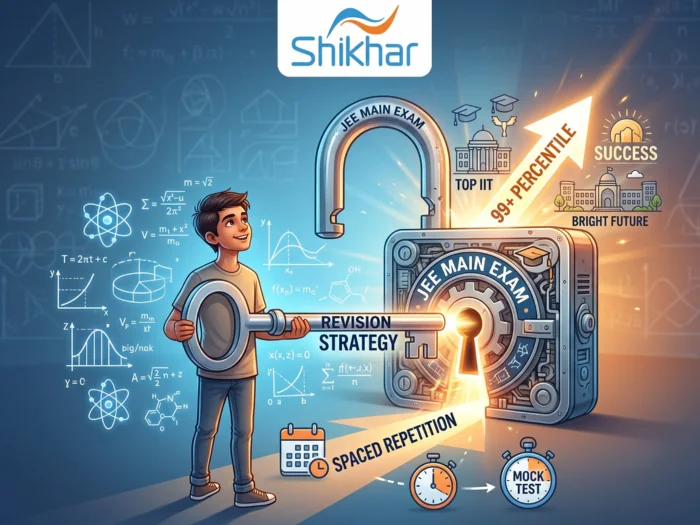
Unlocking the Secret of Successful JEE Main Revision: The Ultimate Guide for 99+ Percentile Students
Every year, the number of students appearing for JEE Main exceeds 12 lakh. Yet, securing a seat at IITs like IIT Bombay or IIT Delhi is not only about working hard but also about having a strategic revision plan. Based on IITians who made it and top coaching institutes like Shikhar Classes and Allen, students scoring above the 99th percentile do not study more but study more intelligently. The distinction is the way they revise.
For Indian aspirants with the highest level of competition and the widest syllabus, a well-organized JEE main revision strategy can be what decides a good rank from a great one. This article will take you through a step-by-step revision plan that covers JEE quick revision methods, subject-wise strategies for JEE Physics revision, JEE Maths revision, and chemistry quick revision for JEE mains, and JEE last minute revision tips to help you succeed in the exam.
How to Prepare a Revision Plan for JEE Main 2027?
Well, the solution to this question will not be a unique and universal recipe but a mixture of tried and tested methods. Drawing from experiences of IITians and education websites such as Shikhar Classes and Cracku, an ideal JEE main revision strategy should be based on three main elements: self-examination, spaced intervals, and focused practice.
You should start by examining your personal competencies and limitations for Physics, Chemistry, and Mathematics. Then, develop a balanced study plan that equally includes revision, solving problems, and working with sample tests. Doing so will allow you to not only remember formulas but also understand important aspects and be able to tackle complicated questions during the exam.
What Role Does Self-Assessment Play in Effective JEE Main Revision?
It is key to first assess one's preparation and to be aware of the current level of knowledge and understanding before starting with the revision itself. Once the weak areas are prioritized, wasted efforts towards the known topics will be avoided. The topmost way to do this is by referring to your marks and scores across various subjects. Afterward, create a list that will consist of all the topics from the JEE Main syllabus together with the confidence level corresponding to each topic.
As an example, if you are good at Calculus but weak in Organic Chemistry, then you will have to spend more time on the latter subject when revising. Such an approach is targeted and maximizes the use of time and effort which is the essential element of JEE quick revision.
In What Way Does Spaced Repetition Help Retain Information?
The proposal to employ spaced repetition is based on research that confirms the advantages of memory and recall improvement over time with different intervals of repetition. In short, instead of covering all the material in one go, you will revisit the same through increasing intervals. For example, after finishing a topic you review it the next day, after 3 days, and then after a week and so on.
This process builds connections in the brain and helps to transfer information from short-term memory to long-term memory. Spaced repetition can be your savior in recalling during the exam everything you memorized: for example, all the formulas and theorems for JEE Maths revision. Also for chemistry quick revision for JEE mains, this method ensures that you recall the reaction mechanisms and periodic trends without unnecessary last moment stress.
Month-Wise Revision Plan for JEE Main 2027
It is a must to have a well-organized schedule for steady development. Here is a timeline of gradual progression:
Months 1-2: Building the Base and Enhancing Understanding
During this period, your primary aim should be to master your basics. Dedicate approximately 60% of your time to understanding concepts while 40% should be allocated for revision. The NCERT course books are sufficient for Chemistry and Physics, whereas RD Sharma is the reference text for Mathematics. Prepare simple formulas for JEE quick revision purposes. At this stage, make sure to lay a solid foundation which is highlighted by Matrix Academy's strategy for 99 percentile scoring.
Months 3-4: Problem-Solving Emphasis and Test-Taking
Make the transition towards using what you know for tackling problems by resorting to previous year papers (PYQs) and mock tests focused on a specific topic. For JEE Physics revision, mechanical and electromagnetic problems should get the most attention. With JEE Maths revision, apart from calculus, one should not ignore the topics of algebra and coordinate geometry. After solving many problems, it is also a must to evaluate mistakes and weak spots again.
Months 5-6: Revision of the Entire Syllabus and Examination Practice
This period is intended to be the JEE last minute revision phase for the candidates. Go through your formula sheets, important reactions, and key theorems once more. You may want to get used to the timed exam environment by taking full-length mock tests based on the actual exam pattern. This is the time when you should focus mostly on the mock tests. Time management and accuracy should be stressed upon solely. For a deeper understanding of how mock tests can transform your preparation, read our guide on the role of mock tests in IIT JEE success.
JEE Main Subject-Wise Revision Strategies
JEE Main's subjects are varied and so is the strategy that one should follow. Here is what you can do to get good at JEE Physics revision, JEE Maths revision, and Chemistry quick revision for JEE mains:
JEE Physics Revision: Understand and Practice
Physics has two components in JEE Main: theoretical knowledge and practical numerical problem-solving. So, for JEE Physics revision, first focus on major scoring topics like Mechanics, Electrodynamics, and Modern Physics. List the significant formulas and derivations that are key to exam success. Make working out problems part of your routine to continually enhance speed and accuracy. Use spaced repetition to memorize core laws and principles such as Newton's laws, Kirchhoff's rules, and wave optics.
JEE Maths Revision: High Priority to Calculus and Algebra
Firstly, the math portion of JEE can give you a high score if only you master the art of solving problems in the most efficient way. For JEE Maths revision, put more effort into learning and practicing the areas of Calculus, Algebra, and Coordinate Geometry. Try solving around 10-15 questions from each topic every day. Previous year question papers will be a great source for getting familiar with the pattern and level of difficulty of the questions. To identify which areas offer the best return on effort, check out our analysis of the most scoring topics for JEE 2026.
Chemistry Quick Revision for JEE Mains: Plan and Execute
Many times Chemistry is the easiest section among the three for those who revise it systematically. This way, for chemistry quick revision for JEE mains, segregate it into Physical, Organic, and Inorganic. When it comes to Physical Chemistry, consider knowing the formulas and solving numerical problems. The topics in which one should work more are mole concept, thermodynamics, chemical kinetics, etc.
As for Organic Chemistry, you may find the visualization of reaction paths most helpful. Then again mnemonics are used for covering periodic trends, coordination compounds, and chemical bonding in Inorganic Chemistry. Using flashcards and concise notes can be a great way to do spaced learning for JEE Chemistry revision.
How to Prepare for JEE 2027 from Now? A Long-Term Perspective
If you're preparing for a long time, planning ahead is best. Here's a step-by-step approach you can follow if you base your study plan on reliable sources like Shikhar Classes:
1. First, get a good understanding of the JEE Main 2027 syllabus and the format of the examination.
2. Review your fundamentals thoroughly with the help of NCERT Class 11 and Class 12 textbooks.
3. After that, select your study materials carefully. If you decide to study on your own, for example, you can use HC Verma for your Physics studies and OP Tandon for Chemistry.
4. As a habit, keep solving previous years' question papers to get comfortable with the exam pattern.
By following these steps, you will lay a solid foundation for yourself and make your JEE main revision a lot smoother. For students wondering when to begin this journey, our expert advice on how early you should start IIT JEE preparation can provide valuable insights.
Why Shikhar Classes is Your Ideal Partner for JEE Main Revision
While studying for JEE can be challenging, expert guidance can transform your journey. Here are some reasons why you should consider tutoring from Shikhar Classes:
- Besides helping with scheduling your revisions, our teachers also give guidance on working on weaker areas.
- Frequent online tests based on past years' papers to keep evolving the level of students.
- Emphasis on understanding concepts which leads to better results in all three subjects.
Whether you dream of being at IIT Bombay or any leading NIT, Shikhar Classes is your one-stop solution for getting top percentiles effortlessly. Join us and give a new structure to your JEE main revision experience. Learn more about our comprehensive approach to IIT JEE and NEET coaching.
Quick Glance at the Ultimate JEE Main Revision Checklist
Double-check these points in your plan:
- Be self-aware by recognizing your strong and weak areas and keep revising because of this.
- Keep on memory through spaced intervals for formulas and theoretical concepts.
- Regularly solving old papers and mock tests results in greater efficiency of time and accuracy.
- Formulate a list of key formulas so that you can have a final recall of Physics, Chemistry, and Maths.
- Give more time and attention during your revision to the topics which have higher chances of appearing like Calculus, Mechanics, and Organic Chemistry.
- Around the last month, do a complete mock examination both in time and environment to get used to it.