Most Important Chapters for JEE Mains: Your Blueprint to Cracking the Exam
Published on July 11, 2026 by Parul Sharan
Most Important Chapters for JEE Mains: Your Blueprint to Cracking the Exam
Each year, more than 12 lakh students from India take the JEE Mains exam, but only the top 2.5 lakh get qualified for JEE Advanced. With this kind of competition, you simply cannot afford to study all the chapters equally. Your smartest move would be to first identify the most important chapters for JEE mains and focus on these. In this post, I will tell you which chapters from Physics, Chemistry, and Maths provide you the highest value for your effort. This will enable you to plan your preparation just like the toppers do.
What Are the Most Important Chapters for JEE Mains Based on Weightage?
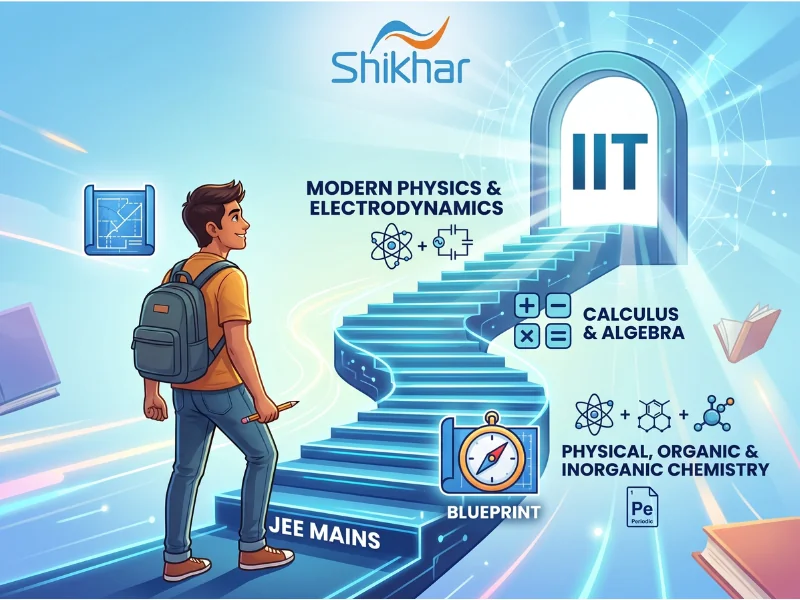
JEE Mains has a pattern that is fairly predictable: approximately 60-70% of the questions come from about 30-40% of the syllabus. Looking at the last five years data, the National Testing Agency (NTA) has been consistently giving a higher emphasis to a few chapters only. For instance, in the case of physics, Modern Physics and Electrodynamics together make up almost 25% of the total marks. However, in Chemistry, Physical Chemistry's numerical-heavy chapters lead the charge. And when it comes to Maths, Calculus and Algebra are the main pillars.
Why Focus on High-Weightage Chapters Alone Won't Work
Prioritizing important chapters is necessary, but at the same time, neglecting the low-weightage topics can be harmful. JEE Mains has a -1 negative marking for every wrong answer. So, your leaving too many chapters unstudied might be your downfall. The best way is to target 80% mastery in all the important chapters and have a good knowledge of the rest. This is a well-rounded strategy that will be leaving you capable of attempting 90% of the paper confidently.
Physics Important Chapters for JEE Mains (High Scoring & Concept-Based)
Physics is the subject that can make a difference between securing an average rank and an excellent one. In Physics, important chapters for JEE mains are the ones that examine both your conceptual clarity and your speed with numericals. Based on the analysis of JEE Mains 2025, these chapters will probably have about 3-4 questions each, meaning a contribution of 12-16 marks per chapter, nearly.
- Modern Physics (Dual Nature, Atoms, Nuclei, Semiconductors): This scoring unit is a big one since the questions are direct, formula-based, and not very tricky. 3-4 questions are what you can expect. Concentrate on photoelectric effect, Bohr's model, radioactive decay, and logic gates. Do at least 100 numerical problems from this unit alone.
- Electrodynamics (Electrostatics, Current Electricity, Magnetism, EMI & AC): 4-5 questions are on this topic, every year, so it is quite a heavy unit. Mainly topics include Gauss law, Kirchhoff's laws, Biot-Savart law, Lenz's law, and AC circuits, alongside practicing the derivations and problems of circuit type.
- Mechanics (Laws of Motion, Work-Power-Energy, Rotational Motion): Mechanics contribute 3-4 questions but its understanding goes deeper. Mostly the bits of centre of mass, moment of inertia, and conservation of energy should be given attention. Most of the students lose marks here due to their mistakes in the calculations.
- Optics & Waves (Ray Optics, Wave Optics, Sound Waves): Compilation of these topics make up 2-3 questions. Ray optics lens formula and wave optics interference/diffraction are quite straightforward. Visuals help quite a bit with remembering sign conventions.
Going back to the main goal, if you are able to master these 4 physics units, you can probably get 40+ marks out of 100 in the Physics section, which is a huge plus for your overall percentile.
Most Important Chapters for JEE Mains Maths: The Score Multiplier
Maths is generally considered by many as the toughest part of a test, but it is also the most scoring one if you focus on the right parts. Most important chapters for JEE mains maths splits the topics as question patterns and solutions based on practice. Calculus and Algebra alone provide nearly 60% of the Maths paper.
Calculus – The Undisputed King (6-7 Questions)
- Differential Calculus (Limits, Continuity, Differentiability, Application of Derivatives): 3-4 questions. Get very good at L'Hospital's rule, Rolle's theorem, and tangents/normals. Several questions are straight out of standard textbooks like RD Sharma or Cengage.
- Integral Calculus (Indefinite, Definite, Area Under Curves): A maximum of 3 questions here. Intuitive definite integrals and areas between curves highlight the best yields. Plus use integration by parts and substitution until it becomes second nature.
- Differential Equations: 1-2 questions. Of course variable separable, homogeneous and linear differential equations are areas to focus on.
Algebra – The Consistent Performer (5-6 Questions)
- Matrices and Determinants: 2-3 questions. Learn properties of determinants, solving linear equations using matrix methods, and adjoint/inverse. Plus these are must-know.
- Probability and Statistics: 2 questions. Conditional probability, Bayes' theorem, and mean/variance of distributions are the main points. Please make use of Venn diagrams for clarity.
- Sequences and Series, Quadratic Equations, Complex Numbers: Together 2-3 questions. Arithmetic/Geometric progressions and complex number geometry feature quite often.
Coordinate Geometry & Vector/3D (3-4 Questions)
Straight lines, circles, parabola, ellipse, hyperbola here, focus on standard forms and tangents. Also, vectors and 3D geometry (dot product, cross product, plane equations) fit well with formulae.
Upon mastering just these maths chapters, you will find yourself able to answer more than 20 questions, thus acquiring 80+ marks out of 120 in the Maths section.
Chemistry Important Chapters for JEE Mains: Physical, Organic & Inorganic Breakdown
Chemistry is the section that is the most balanced of all three branches with equal weightage given to each one. Chemistry important chapters for JEE mains can be divided like this: Physical Chemistry (numerical heavy), Organic Chemistry (reaction mechanisms), and Inorganic Chemistry (memorization). If combined, they are the best source of quick marks if studied properly.
- Physical Chemistry (Highest Score per Question): Topics such as Mole Concept, Thermodynamics, Chemical Equilibrium, Ionic Equilibrium, Electrochemistry, and Chemical Kinetics give 7-8 questions. These are all numericals, and involve formula application. Try to memorize all the key formulas for instance, the Nernst equation for electrochemistry or the Arrhenius equation in kinetics. It is recommended to solve at least 50 numericals per chapter.
- Organic Chemistry (Sequential Learning Required): The necessary chapters are General Organic Chemistry (GOC), Hydrocarbons, Haloalkanes & Haloarenes, Alcohols & Ethers, Aldehydes & Ketones, and Carboxylic Acids. GOC is the foundation to get a grasp on inductive effect resonance hyperconjugation, and reaction intermediates. In the absence of GOC, you are incapable of doing well in reaction-based questions. Mostly, 5-6 questions will be from the organics.
- Inorganic Chemistry (High Recall Value): Periodic Table, Chemical Bonding, Coordination Compounds, and p-block/s-block/d-block elements offer 5-6 questions. Most of the questions are direct statements from NCERT. Like, if a question asks, "Which of these is a diamagnetic complex?" Then, a candidate who has memorized tables from NCERT is well placed to answer immediately.
A clever way to do the chemistry is to finish Physical plus Inorganic first and then proceed to Organic's reaction maps. This can be your leading edge to consistently scoring 70+ marks in Chemistry.
Class 11 Important Chapters for JEE That Build Your Foundation
Quite a few students do not value class 11 important chapters for JEE and this hurts them in class 12 later. Actually, class 11 syllabus comprises 45% of JEE Mains syllabus. The topics here are prerequisites for the tougher ones. Being unfamiliar with them means more importantly struggling afterwards.
- Physics from Class 11: Besides Mechanics (Laws of Motion, Work-Power-Energy, Rotational Motion, Gravitation), Properties of Matter (Elasticity, Fluids, Thermal Expansion) is an area to not overlook. Without a know-how in rotational motion, rigid body dynamics of class 12 is quite a challenge.
- Chemistry from Class 11: Basic Concepts of Chemistry (Mole Concept), Atomic Structure, Chemical Bonding, Thermodynamics, Equilibrium, and Classification of Elements all have their importance.
- Maths from Class 11: Sets & Relations, Trigonometry, Complex Numbers, Quadratic Equations, Sequences & Series, Straight Lines, Circles, Limits, and Probability constitute the foundation. Calculus is nearly impossible without the knowledge of trigonometry.
Keep the first 4-5 months of your prep with complete mastery of these class 11 chapters. When you have a strong foundation, class 12 topics like Electrodynamics, Calculus (integration), and Organic Reactions will become a lot easier for you.
JEE Advanced Important Chapters – How They Differ from Mains
Although this article is on JEE Mains, knowing JEE advanced important chapters is a part of your overall preparation. JEE Advanced is more focused on the test of application and conceptual depth rather than just rapidity of working. While the important chapters for Advanced and Mains are almost the same, the level of difficulty is much higher.
- Physics: Advanced demands deeper understanding of Mechanics (In particular rotational and simple harmonic motion), Electromagnetism (variable magnetic fields, AC circuits), and Modern Physics (X-rays, photoelectric effect with graphs).
- Chemistry: Physical Chemistry in Advanced becomes a multi-step problem, Organic Chemistry involves the use of rare reagents only known through practice, and Inorganic Chemistry encourages students to reason out properties like the stability explained through noble gas configuration.
- Maths: Calculus (definite integrals as limit of sums, area between curves), Algebra (complex numbers geometry, probability distributions), and Vectors/3D geometry are the parts that experience significant increase in difficulty.
Targeting JEE Advanced, Mains important chapters should be prioritized, then spend much time on problem-solving from I.E. Irodov (Physics), Morrison & Boyd (Organic), and A Das Gupta (Maths) books. Besides, Shikhar Classes provide specialized Advanced problem-solving batches that decompose these high-difficulty topics into stepwise approaches.
Quick Glance at the Most Important Chapters for JEE Mains (Checklist)
Here is a summary checklist to keep on your study desk. Mark each chapter as "Completed", "Revision Needed", or "Mastered".
Physics
- Modern Physics
- Electrodynamics (Electrostatics + Current + Magnetism + EMI)
- Mechanics (Laws of Motion + Work-Power + Rotational)
- Optics & Waves
Chemistry
- Mole Concept
- Thermodynamics & Equilibrium
- Electrochemistry & Kinetics (Physical)
- GOC
- Hydrocarbons
- Aldehydes & Ketones (Organic)
- Periodic Table
- Chemical Bonding
- Coordination Compounds (Inorganic)
Maths
- Differential & Integral Calculus
- Differential Equations
- Matrices & Determinants
- Probability
- Coordinate Geometry (Circles, Parabola, Ellipse)
- Vectors & 3D
Print this checklist and review it every Sunday. If any chapter remains unmarked for two consecutive weeks, prioritize it immediately.
Conclusion – Smart Work Beats Hard Work When You Know the Right Chapters
Cracking JEE Mains is not about studying every line of every book. It is about identifying the most important chapters for JEE Mains, mastering them, and revising them repeatedly. In Physics, focus on Modern Physics and Electrodynamics. In Chemistry, prioritize Physical Chemistry numericals and GOC. In Maths, make Calculus and Algebra your strongest pillars.
Use the checklist above, track your progress weekly, and always go back to NCERT for in-text questions. With a disciplined plan and guidance from Shikhar Classes, you can turn these high-weightage chapters into a 99+ percentile score. Start today – your future IIT seat is waiting.
Frequently Asked Questions (FAQs)
Q1: Which chapter has the highest weightage in JEE Mains 2027?
The chapters with the highest weightage from trend analysis are Modern Physics (Physics) and Calculus (Maths) with each one having 4-5 questions (16-20 marks) in the exam. In Chemistry, Physical Chemistry's Mole Concept & Thermodynamics combined provide 3-4 questions.
Q2: How many chapters are there in JEE Mains total?
The official JEE Mains syllabus consists of about 80-85 chapters in total for Physics, Chemistry, and Maths. Still, it is only necessary to thoroughly study the 30-35 most important chapters for JEE mains that will help you score well.
Q3: Is NCERT enough for JEE Mains important chapters?
NCERT is good enough for Inorganic Chemistry and concept building at the basic level. For Physics and Maths, On top of NCERT, you will need practice from books like HC Verma (Physics) and RD Sharma (Maths). For Physical Chemistry numericals, NCERT Exemplar is highly suggested.
Q4: Can I clear JEE Mains by studying only important chapters?
Actually, if you can achieve mastery over the chapters that have high-weightage (accounting for about 40% of the syllabus) and perform at 90% accuracy with these, and also have basic familiarity with the other chapters, you can easily get 160+ marks, which usually is the cutoff score. Even so, to be in the top 20000 rank, you have to study at least 70% of the syllabus.
Q6: What is the 60/60 rule for studying JEE chapters?
Borrowed from the concept of hearing safety: Study for 60 minutes and then take a 10-minute break. Also, avoid studying the same subject for more than 60 minutes continuously. This strategy is good for keeping one's attention span while covering important chapters.