JEE Mistakes: Common Errors Every IIT Aspirant Should Avoid in Preparation
Published on September 4, 2026 by Chetna singh
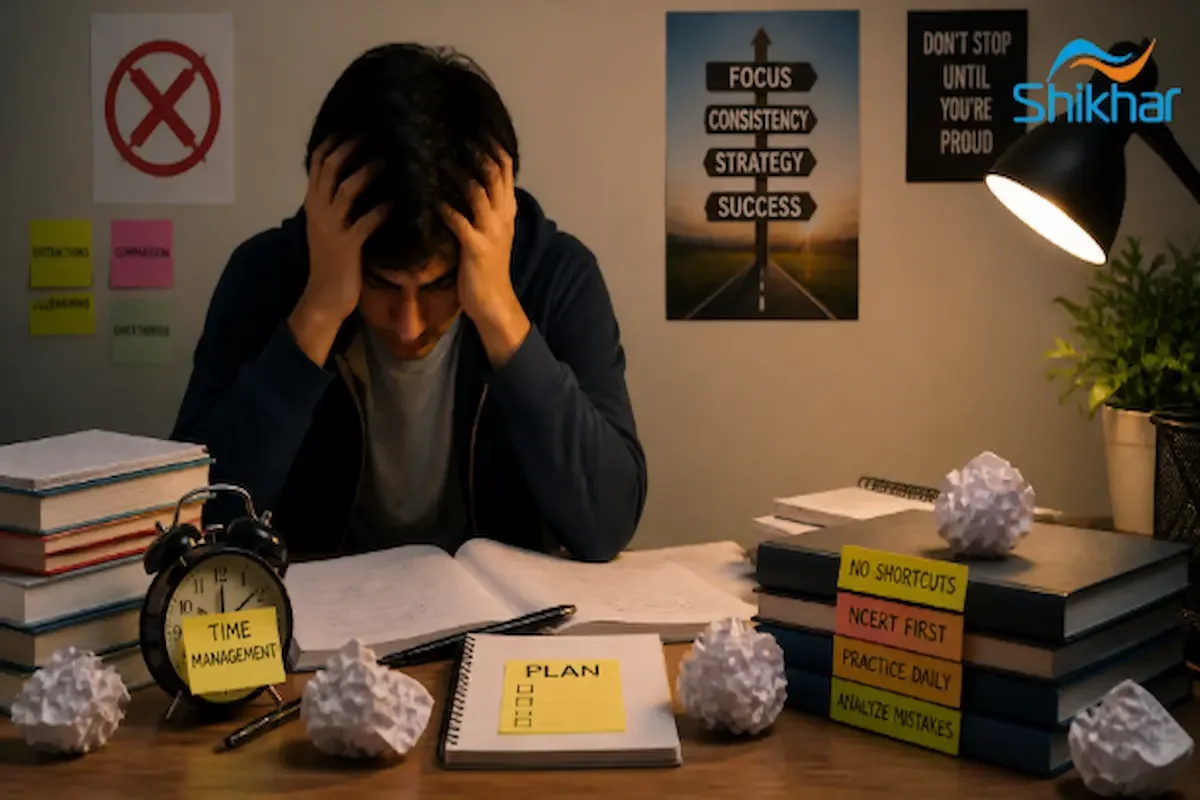
JEE Mistakes: Common Errors Every IIT Aspirant Should Avoid in Preparation
Annually, more than a million students register for the JEE Main and JEE Advanced with the single purpose of securing admission at IITs. The JEE success rate still remains low due to repeating the same group of JEE mistakes by most candidates. In Quora discussions, the answers that receive the most likes and comments mention almost the same mistakes: procrastination, lack of proper planning, and neglect of test practices.
At Shikhar Classes, our staff come across these mistakes repeatedly during each admission session. But the best part is that most of them can be easily avoided, provided you identify them early. If you're just beginning your journey, exploring a comprehensive guide to IIT JEE preparation can help you build the right foundation from day one.
What Are Some Common Mistakes Students Make During Their JEE Preparation?
A mistake during JEE preparation is a stealthy one, in that no mistake will make itself apparent right after the preparation time unless and until the mock-test scores or board results become available. Coaching institute faculty at some big names like Allen, Physics Wallah, and Vedantu, regularly point out the same types of mistakes among students of Class 11, Class 12, and dropper batches.
Apart from academic errors, other behavioral patterns like laziness, comparing oneself with friends, overconfidence, or quitting preparation also result in failure. The very first step toward a clean and efficient strategy is to acknowledge such mistakes, as mistakes are a necessary evil. Understanding the common mistakes NEET aspirants make can also offer valuable cross-disciplinary insights for JEE candidates.
Not Having a Proper Study Plan
Most aspirants kick off their JEE preparation with a positive mindset but without setting realistic short-term and long-term goals. They decide to study a particular subject based on whether they feel like studying it or not, are afraid to confront tough topics, and leave major topics until the last minute. When you do not synchronize your timetable with those of your school, coaching classes, revision breaks, and mock tests, you end up completing your syllabus in a disorderly and incomplete way.
Studying Theory Without Practicing Problems
Only when a student finishes reading a chapter and watching the solved examples is he or she ready to excel in JEE. Still, JEE mainly assesses the ability to apply, and not to passively know. Learners who dedicate 70-80% of their study time to just reading theory and highlighting do not know how to solve numerical problems, even under pressure. It is wise to keep the ratio tilted towards the amount of practice - in Physics and Chemistry, a student should solve at least 3 problem sets for every 1 chapter he or she reads.
What Not to Do During JEE Preparation?
Not only the 'doing it right' list but also the 'don't do it' list is crucial. You should never neglect NCERT, especially for Chemistry, where a good chunk of exam questions come straight from the textbook.
Also, don't avoid doing timed mock tests, don't switch to a new reference book if you're already halfway through a series, and don't measure your progress by how much ahead or behind the top scorers you are. Also, don't give up on sleeping, eating, or relaxing altogether, otherwise, you will burn out, which can lead to dropping your studies halfway. If you feel overwhelmed, learning how to beat JEE burnout can be a lifesaver.
Looking for a JEE Mistakes Book? Build a Smart Study List First
In fact, one of the main reasons for the failure of some JEE students resource-wise was getting overwhelmed with too many books, like HC Verma, Irodov, Cengage, and DC Pandey, and then spending hours and days debating which of all these books to follow. The remedy is to keep your sources limited. Taking one major reference book plus a single problem-solving book or a practice module for each subject.
Start with NCERT books for the subjects of Physics, Chemistry, and Mathematics, as they are the minimum necessary part of your study package. One standard reference per subject is a good addition - Physics would benefit from HC Verma, while the problem part could be from a practice-oriented book or a coaching module. A book like Irodov is only recommended once you are absolutely clear with the fundamentals. This approach makes you less worried about the number of books and gives you time to go into detail in each chapter. For a deeper dive into which resources actually work, check out our guide on NCERT vs reference books for JEE preparation and our recommended JEE study material for 2027.
What Is the 80/20 Rule in JEE?
Based on the Pareto principle, the 80/20 rule implies that nearly 20 percent of the topics in the JEE syllabus contribute to 80 percent of the marks scored in JEE Main and JEE Advanced. Naturally, this rule encourages the students to first focus on the chapters or topics that are most productive, that is, those that carry more weightage, rather than falling behind on the whole syllabus.
Also, even the previous years' papers follow a certain pattern, where only a select number of concepts keep coming up in the form of questions across the papers. Those who use this information correctly get a great insight for their revision, proper scheduling of their study time, and they are very well aware of not going all in when preparing the least likely chapters (low-weightage topics).
Focus First on High-Weightage Chapters and PYQs
Concentration should first be on the chapters and PYQs with high weightage. Modern Physics, Electrostatics, and Current Electricity in Physics are topics that have high weightage in the exam. Coordination Compounds and Organic Chemistry name reactions appear quite often in the Chemistry paper. Calculus and Coordinate Geometry form the major part of the Mathematics paper.
Solve at least the chapter-wise questions of the last ten years, as that will help to learn the pattern and language of the exam before taking a full-length test. If you want to know exactly where to focus, refer to our list of the most important chapters for JEE Mains and the most scoring topics for JEE 2026.
Has Anyone Cracked IIT in 6 Months?
Without doubt, some reports show that there were cases where even six months of intensive preparations by students after they decided to prepare only for JEE resulted in success at the IIT level. Yet, such incidents are not the norm. Practically every such success comes from the candidates who had already studied Class 11 and 12 well and also had an idea of the JEE syllabus.
Therefore, such a short span of time demands very tightly scheduled studying, leaving no room for trial, inconsistent studies, or to be panic-stricken at the last moment and change the plan to something different. If you started preparation late, take this as a rescue move and definitely not a relaxed and slow-paced one. For a structured approach, look at our detailed roadmap to crack JEE in 6 months.
What a Six-Month Strategy Really Demands
To make a six-month plan work, one must be committed to a high-energy routine. You should study for 10-12 hours per day, get rid of distracting apps and socializing, take timed mock tests every week, and concentrate on the chapters that offer the highest possible return along with problems based on JEE previous years' questions.
Even a single omission from these requirements could mean a different result. For most aspirants, the safer approach is a long, two-year study plan, which gives you a better chance to prepare thoroughly. If you're just starting out, understanding when to start JEE preparation is the first critical decision you'll make.
Final Checklist: JEE Mistakes to Avoid during Preparation
Quick Summary of Common JEE Mistakes and Their Solutions
- Build a practical weekly timetable and follow it with consistency.
- Finish NCERT line by line before opening advanced reference books.
- Maintain a 3:1 ratio of problem-solving to theory study.
- Attempt timed full-syllabus mock tests from mid-preparation onward.
- Analyse every test to identify weak areas and silly errors.
- Revise old chapters weekly using the principle of spaced repetition.
- Protect sleep, exercise, and short leisure breaks to prevent burnout.
Going into IIT is like a marathon. The steps you take to correct your mistakes are small, but they accumulate over the months to turn humble daily effort into a prestigious rank. Under the guidance of a good mentor, this whole process of learning can be significantly accelerated. At Shikhar Classes, you will be assisted by a team of skilled educators who will provide you with individualized attention, help you evaluate your test results, and keep you encouraged while preparing for the JEE exam. Explore our JEE and NEET coaching programs to see how structured mentorship can keep you on track.
So, you should fix your habits today and remember that the one who learns quickly by making fewer mistakes will succeed more than the one who just spends more hours studying. For more inspiration, browse through our collection of JEE success stories and IIT JEE motivation tips.
Frequently Asked Questions About JEE Mistakes
How Can I Avoid Silly Mistakes During the Actual JEE Exam?
You make most of your silly mistakes by not reading the question stem properly, making mistakes in unit conversions, and making incorrect guesses with negative marking. You can improve your exam performance and reduce your carelessness by doing timed practice papers and developing a habit of carefully reading each question twice before attempting to solve it. First aim for a high level of accuracy, and then speed will follow as you become more familiar with the exam format. Understanding the JEE negative marking strategy is essential before you sit for the actual exam.
Should I Follow a Topper's Daily Routine?
It is usually not recommended to follow one. It is true that a topper's schedule gives a clue about their level of stamina, areas of competence, and speed of learning, but all these may be different from yours. Instead, it is better to focus your attention on identifying a few productive times a day for studying, figure out your weak areas, and set main goals for a given week to make up a unique schedule. You may draw inspiration from their learning techniques but make sure not to copy their routines blindly. Learning about the daily habits of high-performing competitive exam students can help you design your own effective routine.
Is Coaching Necessary to Avoid JEE Preparation Mistakes?
Attending coaching is not mandatory though guidance through coaching can save you from the pain of experimenting with different schedules and strategies. An excellent mentor will provide you with a roadmap of preparation, evaluate your progress through tests on a regular basis, and resolve your doubts all of which will help you avoid common preparation errors. With self-study too, you can still pass the exam if you are disciplined and have access to the right materials. Just keep yourself accountable at each phase of JEE through mock tests as well as actual exams. If you're weighing your options, read about the top reasons to choose JEE IIT coaching and the importance of coaching classes for IIT JEE and NEET to make an informed decision.