NCERT vs Reference Books for JEE: What Should You Actually Follow?
Published on August 27, 2026 by Chetna singh
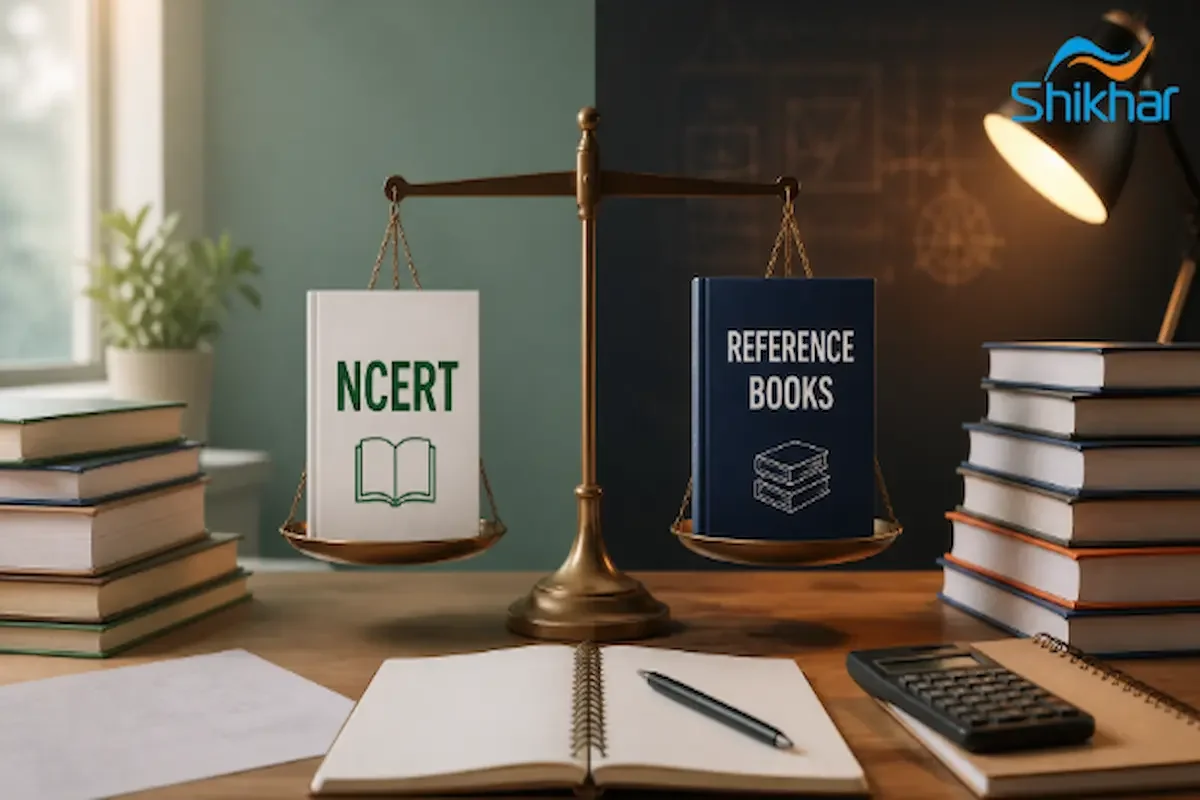
NCERT vs Reference Books for JEE: What Should You Actually Follow?
Year after year, students preparing for JEE Main and JEE Advanced wrestle with the same dilemma: Should they stick to NCERT only, or should they also make time for reference books for JEE?
This debate has persisted for over a decade, sparking countless threads on Quora and Reddit and fueling discussions in coaching rooms where everyone has an opinion. Interestingly, the number of questions derived directly from NCERT textbooks is remarkably high in the last five years of JEE papers, yet top rankers never depend on it completely. This article provides a practical perspective to settle the NCERT vs reference books debate once and for all.
What Is the Difference Between NCERT and Reference Books for JEE?
The distinction lies in the intention and approach of each. NCERT lays out the fundamental principles behind every concept, explaining it in student-friendly, academic language that suits both the CBSE school system and the NTA-mandated syllabus for JEE Mains.
Reference books for JEE, on the other hand, are designed to enhance the brain's ability to recognize patterns through application-focused, multi-layered problem-solving questions. Think of it this way: NCERT is the foundation of the house, while reference books form the upper floors and beyond.
Without a solidly built base, the higher levels cannot sustain themselves. This is why many mentors and teachers emphasize that studying from NCERT books for JEE is the first priority, and no other material should come before that.
Are Only NCERT Books Enough for Preparing for JEE Mains?
Yes, it is possible, but with a few limitations. When weighing NCERT vs reference books for JEE Mains, the NCERT plus the Exemplar edition together is a solid way to crack JEE Main.
Since NCERT is aligned with the syllabus given by NTA, it covers almost every topic the exam tests. Still, in some cases, it is wise to go for one additional reference book per subject besides NCERT—particularly in calculation-heavy areas like Physics and Mathematics, which demand more than what NCERT offers.
Is NCERT Book Good Enough for JEE Advanced?
Not at all. NCERT alone cannot get a candidate to the top in JEE Advanced. This examination tests deep conceptual understanding, multi-stage reasoning capabilities, and problem-solving based on practical applications—none of which are fully covered in NCERT.
Experts from top coaching institutes like Shikhar Classes assert that NCERT is a great starting point for JEE Advanced, but students must rely on reference books in addition and practice problems regularly to master all concepts.
Subject-wise Assessment: Is NCERT Sufficient for Physics, Chemistry, and Maths?
The extent to which NCERT covers the syllabus varies across subjects, making it essential to understand these subject-specific details while developing an efficient preparation plan.
Is NCERT Alone Adequate for Preparing for JEE Mains Physics?
Members of the Reddit thread r/JEENEETards suggest that one must not depend only on NCERT when preparing Physics for JEE. These exams not only test conceptual comprehension but also demand rigorous numerical work, and NCERT Physics doesn't offer enough of the latter.
A good approach would be to learn theory from NCERT, then move to books like H C Verma or D C Pandey for solving numerical problems, followed by tackling previous years' questions. For a deeper dive into the most difficult physics chapters for JEE Mains, check out our detailed guide.
Is NCERT Alone Sufficient for Chemistry in JEE Mains Preparation?
NCERT is most helpful for Chemistry—especially inorganic chemistry, where almost all questions are directly taken from the textbooks. Organic chemistry is also adequately addressed, but physical chemistry requires extra numerical practice using a reference book. NCERT Chemistry and Exemplar should be sufficient for the JEE Mains syllabus.
Is NCERT Enough for Organic Chemistry in JEE Mains?
Apart from inorganic and physical chemistry, students can gain complete knowledge of organic chemistry by thoroughly reading and practicing NCERT. Reactions, mechanisms, and named reactions are all comprehensively discussed, with many JEE Mains organic chemistry questions directly asked from NCERT.
Those aiming for JEE Advanced should nevertheless get one good organic chemistry reference book to develop deep mechanism understanding.
Which Is Better: NCERT or Reference Books for JEE-Level Preparation?
No single book is always better than the other, as different books suit different aspects of learning at different times. NCERT excels at introducing concepts, helping with board exams and Mains.
Reference books, meanwhile, are great for application in challenging contexts, developing pattern recognition, and increasing problem-solving speed. The key isn't choosing between them but using them sequentially—starting with NCERT and adding one structured reference book per subject at graduated difficulty levels for practice.
Is It Possible to Crack JEE Without Reading NCERT?
Although it is possible, it is strongly advised against. NCERT serves as the primary content source for both board exams and JEE Mains, and it forms the foundation even for higher-level JEE Advanced questions solved by toppers.
By bypassing NCERT for fundamentals, you risk gaps that reference books cannot fix—advanced books presuppose mastery of basics, so you might struggle to grasp them. In other words, the probability of failure is much greater than the time saved by skipping NCERT.
What Books Did IIT Toppers Use?
IIT toppers have been remarkably consistent in their preparation methods. Generally, they start with NCERT books for each subject, then move to NCERT Exemplar before turning to standard reference books like:
- Physics: H C Verma or D C Pandey
- Mathematics: R.D. Sharma or Cengage books
- Chemistry: O.P. Tandon or MS Chauhan
After that, they solved previous years' questions ten to fifteen times and took mock tests regularly. Most often, the top book list includes NCERT at the beginning.
How Can One Study NCERT Alongside Reference Books for JEE?
Combining both NCERT and reference books is a winning strategy. Use NCERT as the backbone throughout preparation, while choosing just one high-quality reference book per subject for practicing more difficult problems.
Use the reference book to understand patterns and develop complex problem-solving skills. Then, ensure your preparation is exam-ready by using problem banks and test series that simulate a real examination environment.
Your Final Checklist: JEE NCERT vs Reference Books
1. Cover NCERT thoroughly across all subjects before moving to reference books.
2. Solve NCERT Exemplars for JEE Mains-level problems.
3. Stick to one reference book per subject instead of juggling multiple books.
4. Use reference books for numerical and advanced-level problems.
5. Practice previous years' questions, with 50–70% from the last 5–10 years.
6. Take mock tests regularly and work on correcting mistakes consistently.
Conclusion: NCERT and Reference Books Work Together
The whole NCERT vs reference books question has a simple answer: both are important, but in a particular sequence. Use NCERT books to build the foundation, and reference books for JEE to construct the superstructure.
At Shikhar Classes, our teachers guide students through this very progression step by step, with well-designed preparation plans, ensuring every aspirant follows an objective and exam-focused strategy. Whether you're just starting or refining your approach, the right combination of NCERT and reference books—along with consistent practice—will set you on the path to cracking JEE with confidence.
FAQs
1. Is NCERT enough for JEE preparation?
NCERT is essential for building strong fundamentals and is particularly useful for JEE Main. However, reference books are recommended for numerical practice and advanced problem-solving.
2. Is NCERT enough for JEE Advanced?
No. NCERT provides the foundation, but JEE Advanced requires deeper conceptual understanding, multi-step reasoning, and extensive practice with reference books.
3. Which is better for JEE: NCERT or reference books?
Both are important. Start with NCERT to understand concepts, then use one good reference book per subject for numerical, application-based, and advanced-level problems.
4. Can I crack JEE without studying NCERT?
Although it may be possible, skipping NCERT is not recommended. NCERT builds the fundamental concepts required for both JEE Main and JEE Advanced.
5. How should I use NCERT and reference books together for JEE?
Complete NCERT first, solve NCERT Exemplar questions, then use one reference book per subject for advanced practice. Finish with previous-year questions and regular mock tests.