Beat Burnout During JEE Preparation: A Complete Guide for Indian Aspirants
Published on July 11, 2026 by Parul Sharan
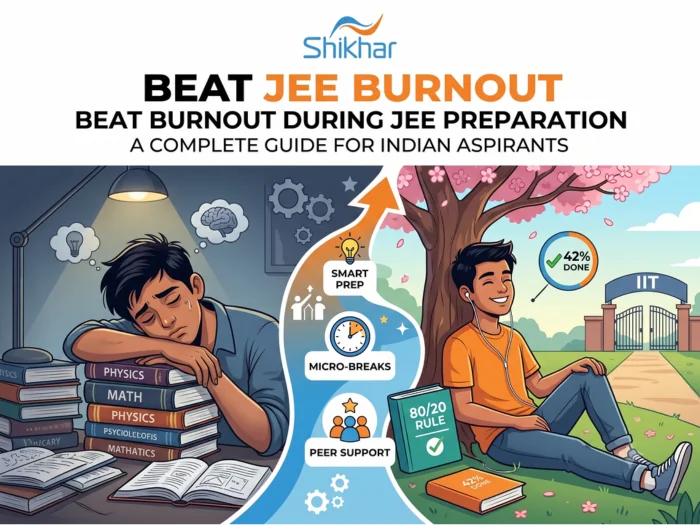
Beat Burnout During JEE Preparation: A Complete Guide for Indian Aspirants
Every year more than 12 lakh students appear for JEE Main but around 60% of them report feeling mentally burnout at some stages of their preparation. Burnout during JEE preparation has become a hidden epidemic resulting in declining mock test scores, dropping motivation and even health issues. The stress to crack India's toughest engineering exam drags aspirants into an endless cycle of overstudying, sleepless nights and isolation.
This guide will assist you in recognizing, preventing and overcoming burnout so that smart preparation is your mode rather than just hard preparation.
How to Avoid Burnout During JEE Preparation – Core Strategies
Burnout is not just exhaustion, but it is emotional, physical and mental depletion due to continuous stress. To escape it, you have to get a plan ready first, rather than just waiting for your breakdown. Firstly, you must know that studying for 14 hrs/day without breaks lowers your memory and problem-solving ability.
The 80/20 Rule (Pareto Principle) for JEE
The 80/20 principle implies that 80% of your JEE marks results from only 20% of the syllabus. Certain topics like Electrostatics, Mechanics, Chemical Bonding and Calculus are always on the exam and scoring well in these ensures success. Use last year's question papers to learn which chapters are most often tested and focus on those. This spares you from low yield topics that, apart from being energy consuming, cause burnout.
The 42% Rule for Time Management
This rule which is quite popular in the productivity world says that you can end your study when you think that 42% of your work is done or that you are 42% done with your time allowance. The last bit of any work takes the most mental energy. By intentionally stopping sooner, you come back refreshed the next day and also won't have totally drained yourself.
Scheduled Downtime as Non-Negotiable
Kalpit Veerwal, an IIT alumnus, suggests having a "zero study halfday" every week wherein no phones and tablets are allowed - only pure relaxation like a walk, music, or a hobby should be done. This is not a waste of time, it simply reboots the brain's reward system and keeps from getting tired over time.
You can make these techniques a part of your everyday life and prevent burnout during JEE preparation from becoming a threat that is almost certain.
Recognising the Warning Signs of JEE Burnout
Until you fix burnout, you have to notice it at an early stage. Most students confuse burnout with laziness or absence of will which only results in further guilt and stress.
Some of the common signals are physical tiredness even after rest, getting easily irritated by little things, no longer being enthusiastic about studies that you liked earlier, headaches and a decrease in mock test scores.
Even on Reddit subthreads related to JEE, students describe "brain fog" as difficulty in focusing, forgetting things and mental slowness. If you have three or more of these for at least two weeks, then you are most probably in the burnout zone. The first step in healing is to admit this without blaming yourself.
Proven Techniques to Prevent Burnout
Prevention is a better option than cure. Here are some ideas from IIT graduates, coaching experts and peers that have been finetuned for JEE.
Micro-Breaks and Desk Meditation
Scientific research has found that even a short break of 60-90 seconds done after 30 minutes of deep concentration is effective in slowing down the process that creates fatigue. During that time, you may do some stretching, shut your eyes, or take a deep breath for 60 seconds.
Immediate Reset Techniques
Burnout is a cumulative process so you can't push it that far if you don't want to. When you feel the symptoms, put down your book right away. Have water because when you are dehydrated, your brain doesn't function properly, then do some stretching exercises of your neck and shoulder muscles, finally leave your study room for about 5 minutes. Momentum is kept only by the situation being changed, so the stress cycle is broken here.
Social Accountability and Peer Support
Avoiding social contact is the same as inviting burnout. Keep joint study sessions (in person or via the internet) and give each other feedback about your daily performance. Winning or losing grades is not as important as doing the daily routine consistently. So, the community supports are mostly around these agreements that "taking breaks is ok".
On a platform like Reddit's r/JEENEETards, aspirants share realistic daily goals and remind each other that it's okay to take a breather. Talking to a friend or family member who rarely mentions always studying acts as a powerful emotional reset.
What JEE Aspirants on Reddit and Quora Say About Burnout
Aspirants' testimonies provide what others want to know the most. On reddit threads like "burnout because of JEE" on r/mumbai and r/JEENEETards, the aspirants are in agreement that it is better to cut down on intensity rather than quitting altogether. Example of one of the best comments: "Take time to rest once in a while, but don't stop working hard. On bad days, just do 2-3 hours of light revision so you don't lose your momentum."
According to some IIT graduates on Quora who have succeeded, de-stressing by taking guilt-free breaks is the key - at least 10 minutes of full mental disengagement every 90 minutes. Here are some additional tips given by them: changing of study location (balcony, library, different room) to refresh your mind. The community's perspective that burnout is a normal and recoverable state is best depicted through discussions about brain fog on Reddit JEE related subthreads.
Quick Glance at Burnout Prevention Checklist
A brief enumeration of the best remedies for not getting burned out during JEE preparation follows:
- Stick to the 80/20 rule: Devote 80% of your time to only 20% of the JEE topics which are of high yield.
- Keep the 42% rule in your mind: After studying for a while, stop when you feel that you are 42% done and thereby save your energy.
- Take a total rest week-half-day: No books, no gadgets, just a combination of rest and laughter.
- Desk meditation for 60 seconds: Breathe and reset every 2 hours of study.
- Immediate recovery: Hydrate and stretch.
- Daily communication: Five minutes on the phone to prevent isolation.
- Sleep over 7 hrs and have nutritious meals: no night studying and junk food.
Conclusion
Burnout during JEE preparation is totally preventable - it is a clear signal that your study method may require alteration, not that you are incapable. You can keep your mental health and academic performance by responding to early warning signs, emphasizing highyield topics, and incorporating microbreaks and social support.
Do bear in mind that thousands of successful IITians have passed through the same difficulty and come out stronger. The team at Shikhar Classes Indore is helping you prepare without the weakness brought about by burnout - offering one-to-one mentoring, savvy study plans, and a group that truly cares. Your JEE dream is of course very important but so is your well-being.
Frequently Asked Questions (FAQ)
Q1: What is the 75% rule for JEE?
The 75% eligibility criterion means that if you want to take admission in IITs, NITs, and IIITs you need at least 75% marks (65% for SC/ST) or you should be in the top 20 percentile of the Class 12 board exams. Ignoring board exam preparation may become stressful because of this rule. Commit 1-2 hours daily to board subjects to balance both JEE and board preparation.
Q2: Can burnout cause brain fog, and how do I fix it?
One of the symptoms of burnout is brain fog( forgetfulness, lack of concentration). You should try to take a full 2 day break from studies, get 8 plus hours of sleep and keep yourself hydrated to stop brain fog. If even after this your brain fog condition gets worsened, you really need to ask a mentor or counsellor for help.
Q3: How do I stay motivated when I feel like giving up?
Make a "vision board" with a dream of IIT, a wallpaper as a message from your future self, or a family photo. Also, breaking the syllabus by making a mix of 5-6 small topics for the daily checklists and ticking them is known to give a dopamine kick. Besides that, find a study group with which you can share progress.
Q4: Is it okay to take one full day off every week during JEE prep?
Definitely. Actually, planned breaks are a must. Have one no-remorse day off every week when you do no academic work at all. You can use the day for your hobbies, meeting friends, or sleeping. You will come out more focused and productive.