JEE Paper 1 vs Paper 2: Pattern, Marking and Question Types
Published on November 6, 2026 by Chetna singh
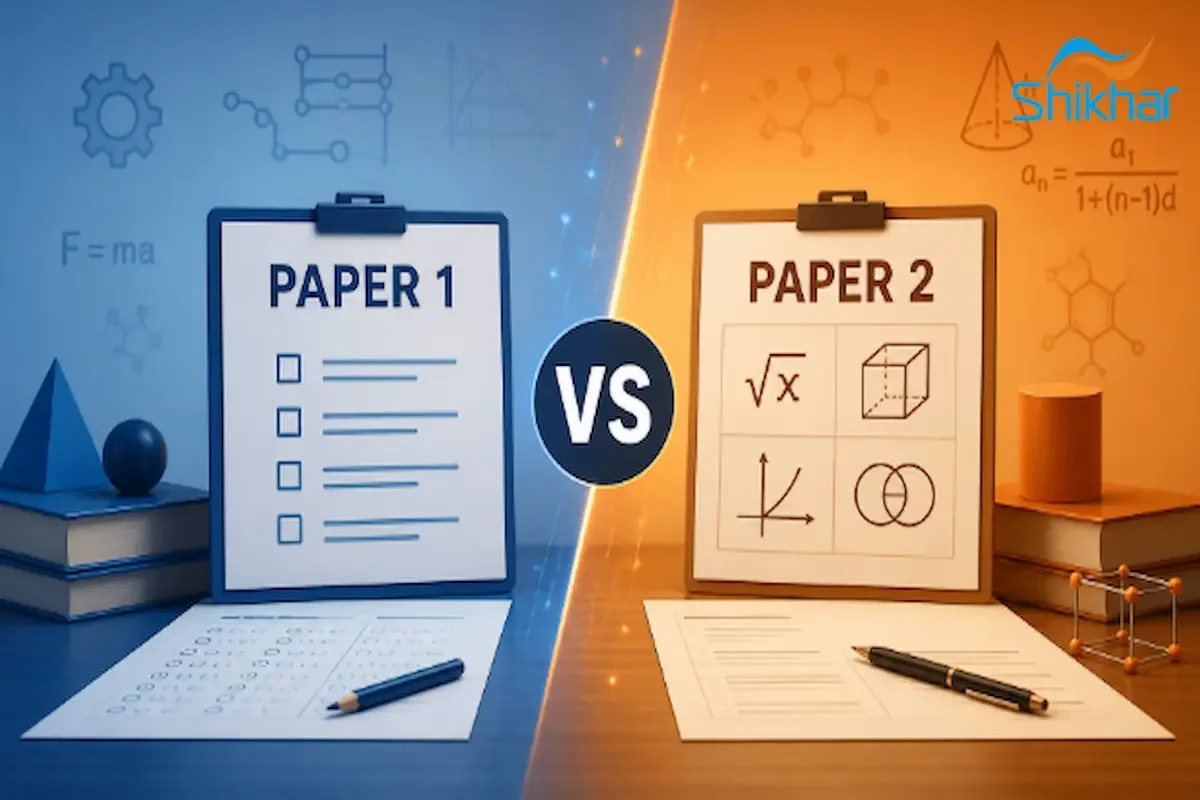
JEE Paper 1 vs Paper 2: Pattern, Marking and Question Types
JEE paper 1 vs paper 2 is a common search among JEE aspirants, but consider which exam they are referring to JEE Main or JEE Advanced. In JEE Main – Paper 1 is for B.E./ B.Tech and Paper 2 is for B.Arch/B.Planning. While in JEE Advanced – Paper 1 and 2 are two compulsory papers in Physics, Chemistry, and Mathematics. Here we would be looking at JEE Advanced where the real JEE paper 1 or 2 confusion arises out of question mix, marking and exam-day strategy.
What Does JEE Paper 1 vs Paper 2 Mean?
Every eligible student for JEE Advanced is required to appear for both Paper 1 and Paper 2, as both have the same three subjects, and the only difference is in the manner of asking questions, the pattern of awarding marks, and speed, accuracy, and calculation-based problem-solving style.
JEE Advanced paper 1 and paper 2 difference
The syllabus remains the same for both JEE Advanced paper 1 and paper 2. Both papers consist of Physics, Chemistry, and Maths subjects and are generally conducted on the same day in two different shifts. What sets them apart are the variations of questions and difficulty levels and marking trends year by year.
Why are there 2 papers in JEE Advanced
Two papers limit the luck factor. One three-hour paper can either set up blind guesswork, or advantage someone at ease with one question format. Two papers offer a wider sample of a candidate's ability (MCQ, MSQ, MLT, and NNI). They also provide an endurance test: a poor Paper 1 should not determine your rank, if you maintain your composure for Paper 2. For Shikhar Classes students, this is also why we practice two papers with 2 head-to-head sectional timers, rather than one extended mock.
How many questions are there in JEE Advanced and Marks?
The exact count is year-specific. In 2025, there were 51 questions per paper, while some earlier patterns had 54. Each paper usually covers three subjects with roughly equal weightage. Total marks are generally 180 per paper, making 360 in total, but always check the official brochure because partial marking and question mix can change the effective score.
1. Number of questions: Treat 51 and 54 as "recent patterns." Don't have an iron clad rule for this. (Note: you want to learn the structure of the current section before taking the test, if at all possible.)
2. Marks: Remember not to learn only 180 or 360. Know how you get full, partial, and negative marks for each question type.
3. On the Subject Split, Physics, Chemistry, and Mathematics generally tend to be weighted equally. If you are not good in one subject, it will adversely affect both the papers. Balance your revision.
Question Types and Marking Scheme
Common Question Types: MCQ, MSQ, MLT and NNI
1. MCQ: this is something you are used to. For each question, choose one answer (wrong answers almost always earn you a negative mark).
2. MSQ: more than one of these choices may be the correct answer, and partial marking could give marks for some of these choices. Take note of instructions before responding.
3. MLT Matching list type questions require you to match columns. They test the concept links and not recall formulas.
4. NNI: Non-negative integer questions require a number answer. There's typically no negative marking but it still pays to be precise.
Marking Scheme: Paper 1 vs Paper 2
The general marking principle is the same but the context of the question changes the risk. Single-correct questions discourage wild guesses. MSQs (multiple-select questions) encourage some partial knowledge. NNIs (no-number questions) encourage precise calculations. Because the precise marks are different every year and with different question types, don't take anything from social media for these.
Is Paper 2 Harder Than Paper 1?
There isn't a recognised 'harder' paper, only individual factors like year, shift, and your tested strengths. Paper 1 is known as standard because the pattern could be familiar, while it might seem long and unfamiliar in Paper 2.
If you are confident in multi-concept questions, you may find the Paper 2 style more manageable. Shikhar Classes exam analysis after mock exams will demonstrate if a paper was scored poorly because of missed concepts, choosing the wrong answers or impatience.
Final Checklist for JEE Paper 1 vs Paper 2
- Both JEE Advanced papers are mandatory and they cover PCM.
- The same syllabus; question mix and marking behaviour may vary.
- Verify the number of questions for each year and the total marks.
- Practise MCQ, MSQ, MLT, and NNI while following negative-marking discipline.
- Think of Paper 1 and Paper 2 as two different shots.
JEE Paper 1 vs Paper 2 is not a syllabus difference but two attempts of the same syllabi. Work on question-type fluency, partial-marking judgements and reset-you-after-isolation between the shifts. At Shikhar Classes, we handhold JEE aspirants with paper-wise mock tests, error analysis and exam-day strategies so that both papers make them look easy and one.
FAQs
What are the eligibility criteria for JEE Advanced?
You need to be in the top 2.5 lakh in JEE Mains, should satisfy age and attempt limits and also the Class 12 requirement as per the JEE Advanced brochure. Always check category specific conditions on the official JEE Advanced site.
Total marks of JEE Advanced and JEE Advanced Paper 1 and Paper 2 total marks
Contemporary trends are often available at around 180 per paper and 360 for the aggregate. Because marking can vary, please check the current total from the information brochure.
JEE Mains total marks cut-off
Total marks and cutoff vary with the session, category, and difficulty. Do not depend on the old screenshots of the cutoff. Make sure to keep an eye on the updated NTA and JoSAA notices.