JEE Marks vs Rank: Previous Year Trends and Analysis (2020–2026)
Published on October 30, 2026 by Chetna singh
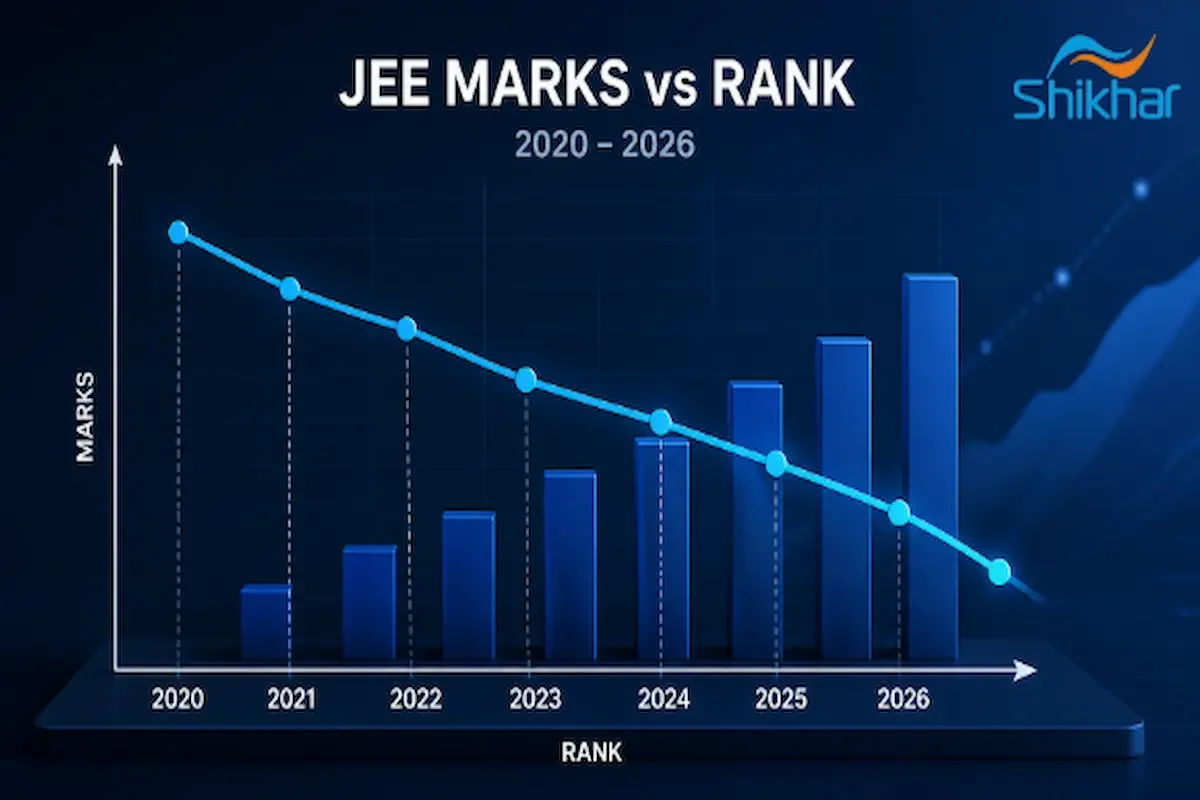
JEE Marks vs Rank: Previous Year Trends and Analysis (2020–2026)
Over 12 lakh students appear in JEE Main each year and, a few hours after the result is announced, almost every student faces the same question: what does my score actually mean? The problem is that NTA never releases a marks-to-rank table. You get an NTA score with a percentile up to seven decimals—and that's it. This guide does the calculation for you based on last year's trend in JEE Main and JEE Advanced and looks at how the numbers have changed since 2020.
What Does "JEE Marks vs Rank" Actually Mean?
The phrase refers to a sequence of three connected values rather than a single lookup: your raw marks out of 300, the NTA score and percentile published by NTA, and the All India Rank calculated from that percentile.
Since JEE Main is conducted in multiple shifts with different papers, the same raw marks in two shifts do not have equal significance—normalisation first converts both scores into a standard NTA score. Understanding this sequence is important, as students sometimes compare raw marks with friends from other shifts and mistakenly assume their ranks are similar.
How Is JEE Main Rank Calculated From Marks?
1. Raw marks into an NTA score. Each paper in each slot will be normalised to take into account the difficulty of that particular slot, so the more difficult a paper, the more the normalised score for the same raw marks will be.
2. NTA score is percentile. If you are used to calculating percentile, then it is simple as 100 multiplied by those who scored less than or equal to you divided by total candidates appeared for that session.
3. Percentile is a rank. Your rank is calculated at (100-percentile)/100*candidate pool size where two sessions are conducted; higher NTA score between two sessions is considered.
JEE Mains Marks vs Rank 2026
For JEE Main 2026, assume all tables are projections based on 2023, 2024 and 2025 data rather than NTA actually releasing data. The bands below are based on recent-year (2024 and 2025) behaviour and will be most relevant to a student trying to gauge what their expected rank might be before counselling.
And note the slope: around 1,600 to 2,100 of the ranks are within 10 marks or so of each other at this end of the range. That's why a narrow gap between scores at the top is so significant on results day.
JEE Marks vs Rank: Previous Year Trends and Analysis 2020 to 2022
The three cycles are examined in more detail than any others because each one irregularly affected the usual marks-to-rank relationship. By looking at them side-by-side, it's clear why a rank derived from the result of a single year will be so confusing.
1. 2020. Two sessions took place, with the second delayed until late in the year due to the pandemic. The candidate pool changed a lot between the sessions. Ranks within the same percentile band were more spread out than in a typical single-cycle year.
2. 2021. 4 sessions were initially scheduled and 2 sessions were rescheduled, so normalisation took place over a larger number of sessions than usual. Students were able to compare raw marks across the sessions, and saw some of the most extreme percentile differences in history.
3. 2022. An unprecedented number of candidates, with two complete sessions, led to compressed ranks: the same percentile corresponded to a higher numerical rank than in previous years, simply because more students were in the queue.
JEE Advanced Marks vs Rank: A Different Curve
JEE Advanced operates under different principles than JEE Main. It is organized by the IITs, features a distinct total score (typically around 360 across two papers, though the format has changed at times), and assigns ranks directly rather than using percentiles.
The correlation between JEE Advanced marks vs rank is highly non-linear—at the highest scores, a small difference in marks can shift a candidate several hundred ranks, while in the middle range, the same difference has much less impact on rank.
JEE Advanced Score vs Rank: What the Trend Shows
If we look at the last few years, the curve gets steeper on both ends of the spectrum and flatter in the middle.
The secret ingredient is the seat numbers, which change on every cycle. The more seats there are, the further the ranks are pushed away; the fewer seats, the closer they are pulled in, regardless of how the paper was set.
JEE Mains Marks vs Rank, Category Wise
Candidates are assigned a Common Rank List (CRL) rank and, if applicable, a category rank (EWS, OBC-NCL, SC, or ST). The category rank is based only on the competitors within the relevant category, which means it's almost always a smaller, more flattering number than the CRL. When it comes to seat allocation in JoSAA counselling, the category rank and last year's closing ranks are used, which is how a student with a disappointing CRL can still get a good branch.
Final Checklist Before You Trust Any Rank Predictor
- Check if the table displays raw marks or NTA score.
- Verify what year of data the projection refers to.
- Read a rank always as a band, never a single figure.
- Verify your category rank independently of your CRL.
- Compare shift difficulty before comparing your grades with friends.
The consistent pattern since 2020 is that JEE marks vs rank changes each year, influenced by the number of candidates, exam shift difficulty, and seat availability. Tables should be viewed as ranges, and it is best to compare data from two or three years to get a clearer picture.
Planning for counselling is more useful than focusing on a single number. At Shikhar Classes, we guide students through this conversion process using previous-year trend sheets, helping them match their scores to realistic college and branch options before choice filling starts.
FAQs
Does my shift change my percentile?
It can. Normalisation is meant to even out the difficulty of the papers, but the standard deviations with very hard/easy papers do still show up at the same raw marks in the percentile difference.
Is 150 marks good in JEE Main?
150 marks is typically near the 99 percentile range (roughly 6,800–9,000 rank). This is good enough for NIT and IIIT branches in most states; still, the particular branch also depends on your category and home state quota.