NEET OMR Sheet 2027: Avoid These Common Filling Mistakes
Published on July 11, 2026 by Parul Sharan
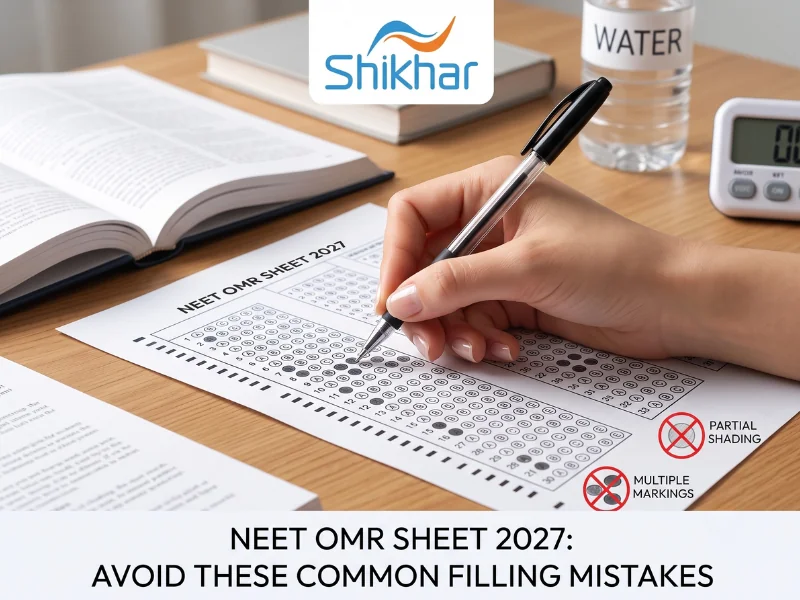
NEET OMR Sheet 2027: Avoid These Common Filling Mistakes
Every year, over 15 lakh medical aspirants appear for the NEET exam across India, and a significant number lose precious marks not because they didn’t know the answers, but due to avoidable errors on the NEET OMR sheet. The Optical Mark Recognition (OMR) sheet is the only document that determines your score, and any mistake made while filling it can be disastrous for your medical career.
Whether you are a first-time test taker or a repeater, understanding the nuances of the NEET exam OMR sheet is critical to converting your hard work into a high percentile. In this comprehensive guide, we will walk you through every possible pitfall and how to steer clear of them.
What Are the Most Common NEET OMR Sheet Mistakes?
The core question every NEET aspirant asks is: “What mistakes ruin my OMR sheet?” Based on analysis of thousands of student errors and NTA guidelines, the most frequent mistakes fall into three categories –
- Shading errors,
- Identification errors, and
- Physical damage to the sheet
Understanding these beforehand can save you from losing marks unnecessarily.
Partial Shading or Light Shading
Owing to time-saving, many students fill in only the centre or shade lightly. So, the machine reads the question as "unanswered", and the students get zero marks. Use a black ballpoint pen, press firmly and shade the bubble completely so that no white spots remain.
Double Bubble or Multiple Markings
Marking two options in the same question is a deadly mistake. The OMR software usually considers the darkest bubble. Sometimes, if there are two equally dark bubbles, the system will mark it as an "invalid response."
In the NEET, pen marks attached to wrong answers result in the marking of invalid responses as wrong answers and one mark is deducted. To be on the safe side, do not change an answer once you have shaded it.
Question Number Misalignment (Psychomotor Error)
At the very last moment, most students end up putting the answer for question 55 in the row of the bubbles meant for Question 54. The main reason for such a slip in action is the lack of sufficient time to finish the last 10-15 questions. It is highly advisable to fill in the answers in groups of 20 and immediately after shading, verify that the question number written on the OMR sheet agrees with the question number in the booklet.
Critical NEET OMR Sheet Shading Errors to Avoid
It looks like a piece of cake to shade, but the wrong technique is the leading cause of machine rejection. The condition of one bubble imposed by the NTA is very strict. If you deviate from it you may see a loss of your marks.
The “Lazy Shading” Paradox
Some of the students nowadays are under the impression that what really matters is to save time by marking a small dot or a tick inside the bubble. This is the most dangerous misconception that a human being can think of. The light sensors of the scanner inspect the dark area. The tiny dot only fills up less than 10% of the bubble and will be recognised as "no answer."
Scribbling vs. Controlled Shading
The blots, when scribbled quickly, will cause incomplete shading and will also cause ink to spill outside the boundary of the bubble. The ink which spilt outside may cause a shadow, and this confusion may result the scanner perceiving it as a stray mark. The right way is to go through the back-and-forth movement or circular strokes, which are well controlled and only inside the bubble.
Single Stroke Inadequacy
In most cases a single quick stroke leads to the sections of the bubble not being covered by the ink and there will be white spots mostly at the edges. The answer is that you should make 2-3 passes over the bubble in a circular manner to achieve uniform darkness from edge to edge.
If I Fill 2 Bubbles in the OMR Sheet in NEET, What Happens?
This mistake tops the most searched list of NEET mistakes and the answer is harsh and straightforward. The OMR machine detects more than one bubble marked in a single response and it then produces the label of "invalid response" or "multiple marking." Actually, the NEET uses negative marking for wrong answers which means that one mark will be taken away from your total score for the "invalid response."
Can We Fill OMR Sheets With Pencils in NEET?
The correct answer is a complete NO. The NTA very clearly states that the use of a black ballpoint pen is compulsory. Graphite in pencil lead is reflective of light in a different way than ink and because of this, the reading of the OMR scanner might be very inconsistent. Also, the pencil marks are erasable which is completely against the exam security regulations.
In Which Case Is a NEET OMR Sheet Rejected?
Knowing the rejection criteria is equally essential as knowing how to fill the sheet. These are some of the very common reasons why the NEET OMR sheet was rejected.
How to Fill OMR Sheet PDF – Step-by-Step Guide
We have here a stepwise written guide with the coverage of every field on the NEET OMR sheet.
Step 1 – Candidate Information Section
Clearly write your Roll Number in the provided rectangular boxes at the top. Afterwards, fill in the bubbles matching each digit of the Roll Number. The written number and the filled bubbles should totally correspond to each other as any difference might cause the cancellation of your candidature during the manual verification process.
Step 2 – Test Booklet Code
Your question paper booklet has a code, like A B C, or D. You will need to darken the bubble under the heading of "Test Booklet Code" which matches yours to avoid being disqualified from the examination since your answer key cannot be matched without this code and the sheet will be deemed as invalid.
Step 3 – Answer Filling Strategy
Refrain from shading all your answers in one go. It is better to keep marking answers in batches of 20-25 questions. At the end of each batch, take a short break for 10 seconds to cross-check whether the question numbers and the bubbles are aligned. Make use of a firm and consistent press black ballpoint pen.
Step 4 – Signature and Invigilator Area
Sign only in the candidate's signature box. The invigilator's area should not be used either for writing or signing. Make sure that your signature here is the same as the one on the admission ticket.
Quick Glance: Final NEET OMR Sheet Checklist
Before you hand over your OMR sheet on exam day, run through this mental checklist:
- Every bubble has been fully darkened with no white spots visible
- Only one answer per question has been shaded
- Test Booklet Code bubble has been appropriately filled
- Roll number has been written AND properly bubbled, both matching
- There are no stray marks scribbles writings outside the bubbles
- The sheet is clean, dry and not folded - no creases or tears
- Only black ballpoint pen has been used throughout
Conclusion
Knowing the answers is only part of your NEET preparation; transferring those answers accurately to the OMR sheet is equally important. A single error in marking or an incorrect booklet code can nullify months of effort.
You can make sure your efforts reflect your score by learning the mistakes people commonly make - from partial shading to physical sheet damage - and adhering to the step-by-step instructions given above. At Shikhar Classes Indore, we help you prepare for the NEET exam comprehensively, covering all aspects, including the NEET OMR sheet. Keep calm, shade accurately and be confident that you left nothing to chance.
Frequently Asked Questions (FAQ)
Is the NEET OMR sheet released before the exam?
Yes, and the information bulletin, NTA issues a specimen NEET OMR sheet. You can get the NEET OMR sheet PDF from the official NTA site for practising marking techniques and getting familiar with the layout.
How to correct mistakes in the OMR sheet during the exam?
Officially, you are not allowed to correct mistakes. NTA does not supply erasers, whitener, or extra sheets. If you realize an error after marking, the only option is to leave it as is. This is why careful, paced marking is a must and is your only form of prevention.
Can we staple or fold the NEET OMR sheet?
No. Stapling, pinning, or folding the OMR sheet is strictly prohibited. Physical damage to the sheet such as creases can jam the scanner or create false shadows which will lead to the rejection of the sheet.
What happens if my OMR sheet gets wet due to sweat or water?
Paper is damaged and ink can spread or the sheet can tear during scanning if it gets wet. Keep the sheet dry and do not place it near water bottles or on a sweaty desk. If your palms sweat, carry a handkerchief and wipe your hands before holding the sheet.
How to fill the OMR sheet in Olympiad vs NEET – is it the same?
Mostly the idea of darkening the bubbles is similar for all competitive exams but NEET has much stricter rules. For example, Olympiad exams may allow pencils or other types of pens but NEET is strictly ONLY black ballpoint pen. Always follow the particular rules of the exam you will take.