NEET MCQ Mastery: Your Complete Guide to Cracking the Exam with Smart Practice
Published on July 11, 2026 by Parul Sharan
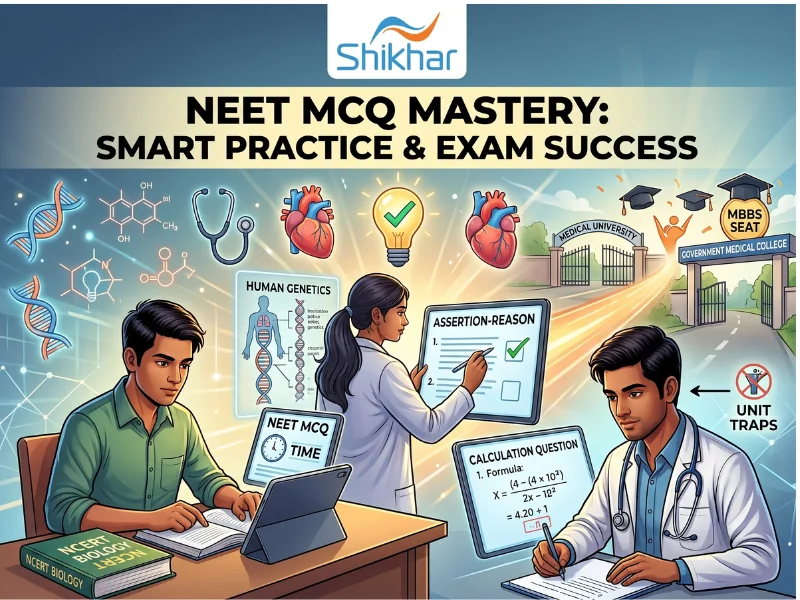
NEET MCQ Mastery: Your Complete Guide to Cracking the Exam with Smart Practice
NEET is one of the competitive tests in India, as over 20 lakh candidates vie for around 2 lakh medical seats each year. The major factor that sets successful candidates apart is their command over NEET MCQs. 180 questions in 180 minutes means speed, accuracy, and clarity of concepts are essential for survival.
Learning how to handle multiple-choice questions effectively may be what separates a seat in a prestigious government college from an unfortunate repeat year, whether you're a beginner or in your last revision. This article shall dissect everything about NEET MCQ practice, right from drills by chapters to the trickiest questions and the best material available to you.
What Are NEET MCQs and Why Are They Crucial for Your Exam Success?
NEET MCQs are multiple-choice questions intended to assess a student's level of understanding in Physics, Chemistry, and Biology (Botany & Zoology). Each question comes with four options, only one of which is the correct answer. The whole paper includes 180 MCQs. Physics and Chemistry have 45 questions each, and Biology has 90 questions.
Practicing NEET MCQs regularly is the biggest weapon for Indian medical aspirants to use throughout the preparation phases.
- Firstly, it accords awareness with the exam pattern and derives confidence on the D-day.
- Secondly, solving issues constantly results in quickness - it is a common problem that most candidates find it hard to solve all 180 questions within three hours.
- Lastly, it becomes a very handy tool in detecting the weak areas which might need thorough revision. Reports from coaching centers depict that candidates who solve more than 10,000 MCQs during their preparation have an average of 50+ scores higher than those who commit themselves to theory only.
How to Identify and Avoid Trick Questions in NEET MCQs
Trick questions are among the toughest obstacles for students taking NEET MCQs\. These are questions with options designed to mislead or are changed slightly in wording. To the untrained eye, such questions may look straightforward, but they contain distractors that are capable of misleading even perfectly prepared students.
Take for instance an item that calls for a "correct statement, " but while one of them is entirely accurate, the others are only partially correct. Another example is confusing biological terms that are similar in sound or swapping units in Physics questions.
Common Traps and How to Overcome Them
- The NCERT Wordplay Trap
- Numerous NEET MCQs change a single key word from the NCERT textbook by a near-synonym that in fact changes the whole meaning. Always do a side-by-side comparison of the option and the NCERT line. If it is just the wording that is off by one word, it is most probably a distractor.
- The "All of the Above" Illusion
- If you are, by any chance, faced with "All of this" as a choice and you don't know the answer, do not go for it. Many times, one of the statements is false, which makes the whole choice incorrect. So, work each sub-statement individually.
- The Numerical Mismatch
- Physics trap questions may be providing data in different units (for example cm vs. m) or including surplus information that is not essential to finding the solution. First, focus on checking the units and understanding the main formula. Practice spotting irrelevant information quickly.
Doing intentional exercises with trick questions is very beneficial. In Shikhar Classes, our MCQ modules focus on such distractors to help students develop the automatic "trap radar" even before the exam.
NEET Biology MCQ Chapter Wise: The Smart Way to Build Your Foundation
Biology has the highest distribution of marks in NEET - 90 questions out of 180, which makes it the subject in which one can score highest, if proper preparation is done. Chapter-wise MCQ practice is, by far, the most powerful technique. Instead of taking random questions from different chapters, concentrated practice on one chapter at a time, for instance, "Human Reproduction, " "Biotechnology, " or "Ecosystem, " will allow you to reinforce the knowledge of that single topic effectively, to find out which chapter you are not so good in, the one that needs going through the NCERT again.
Take the "Genetics" topic from NCERT for example, after you have studied the chapter, complete 50-100 neet biology mcq chapter wise questions based solely on that unit. Doing so deepens understanding of the Mendel's laws, chromosomal disorders, and DNA replication.
Almost all toppers advise building up a collection of 300-500 questions for each Biology chapter throughout one's preparation. Besides, Biology MCQs are often revisiting the same concepts already covered in the previous years, so by exposing yourself to a large question bank, you greatly increase your likelihood of encountering questions that are familiar to you on the day of the exam.
Mastering 'Match the Column' and Other Challenging MCQ Formats
Some NEET MCQs do not stick to the usual question that asks for one right answer. "Match the Column" questions remain very popular, mostly in Biology. Usually, Column A consists of terms (e.g. hormones, enzymes, or scientists), and Column B is made up of their descriptions or functions. You are required to match each one from Column A to one or more in Column B. These draw on associative memory and conceptual linkage but not simple memorization.
Recently, we have seen an increase in the "Assertion-Reason" type of questions. As the name suggests, you have to judge whether both statements are true and if the reason logically explains the assertion. The key to succeed here is detailed reading - there are times both are true but the connection is false. Only through purposely challenging yourself with these types of questions, which are part of resources like the MCQ banks at Shikhar Classes, can one achieve the precision needed to be error free in such formats.
Quick Glance: Your NEET MCQ Practice Checklist
- NCERT first, MCQs second – Never solve MCQs if you haven't thoroughly read the relevant NCERT chapter at least twice.
- Chapter-wise before full syllabus – Start with focused practice on one chapter at a time, then move to mixed tests.
- Trap question awareness – Spend time analyzing why you got a question wrong. Was it lack of knowledge or a clever distractor?
- Timed practice – Regularly take mock tests of 180 questions to develop the speed and mental stamina needed for 3 hours of examination.
- Use multiple formats – Combine online tests, PDFs, and physical MCQ books to get the best of them.
- Review solutions actively – Merely reading the solution is insufficient. After 24 hours, try to solve the incorrect question without looking at the answer.
Conclusion
Learning to deal with NEET MCQs goes beyond simply answering a large number of questions - it is a matter of selecting and practicing the right questions with the right method. From the understanding of trick questions and non-standard formats like "match-the-column" to the use of chapter-wise practice for Biology and downloadable PDFs for Physics, each tip mentioned in this article has been created with the primary aim of helping you increase your score.
Being consistent, analyzing errors thoroughly, preparing oneself to face the real exam condition through simulation of the exam - these are the three aspects that lead to success. Shikhar Classes is dedicated to offering the Indian medical aspirants authentic, up-to-date, and well-structured MCQ resources that can effectively complement the hard work with smart work.
Frequently Asked Questions (FAQ)
Q1: Where can I get free NEET MCQ PDFs with answers?
There are many education websites and coaching institutes that provide free NEET MCQ PDFs with answers. To confirm the relevance of the material, always make sure it corresponds to the latest NCERT syllabus and NEET pattern. Government portals, e.g. NTA's official site, also release the previous years' question papers in PDF form. With samples, Shikhar Classes may be helping you decide if their quality is up to your expectations before making the final purchase.
Q2: Are NEET MCQs only from NCERT, or do I need extra books?
About 80-85% of NEET MCQs come directly or indirectly from NCERT textbook content, especially Biology. For Physics and Chemistry classes, while NCERT is a starting point, it is advisable that you try to get some more MCQs from your reference books or coaching materials to better understand the concepts and have ample practice on numericals. Don't lean on one source alone.
Q3: How many NEET MCQs should I solve daily?
The number of NEET MCQs solved daily by a student who is in preparation mode should be about 100-150, which are divided roughly like this:
- Biology - 50
- Chemistry - 30-40
- Physics - 30-40
On days designated for revision, one can go up to 200-250 MCQs but it would be prudent to remember that quality should always take precedence over quantity. And don't forget to analyze your mistakes.
Q4: What is the difference between NEET MCQ and NEET PG MCQ?
NEET is a test for undergraduate medical admissions (MBBS/BDS) and NEET PG is a test for postgraduate medical courses (MD/MS). There is a big difference in the level of difficulty and the syllabus of these two exams. NEET PG MCQs are closely related to clinical practice and are complicated. This write-up is about NEET UG MCQs. For NEET PG preparation, specialized mcq books for neet pg and resources are required.
Q5: Which is the best MCQ book for NEET preparation?
Different people have their own favorites, so there cannot be a 'best' book identified unanimously. Frequently used ones are MTG's NCERT at Your Fingertips for Biology, DC Pandey for Physics, and OP Tandon for Chemistry. Besides these, you should certainly try Shikhar Classes which offers an MCQ bank integrating chapter-wise questions, previous year papers, and mock tests together.