How to Master JEE Preparation Along with School: A Complete Guide for Indian Students
Published on July 11, 2026 by Parul Sharan
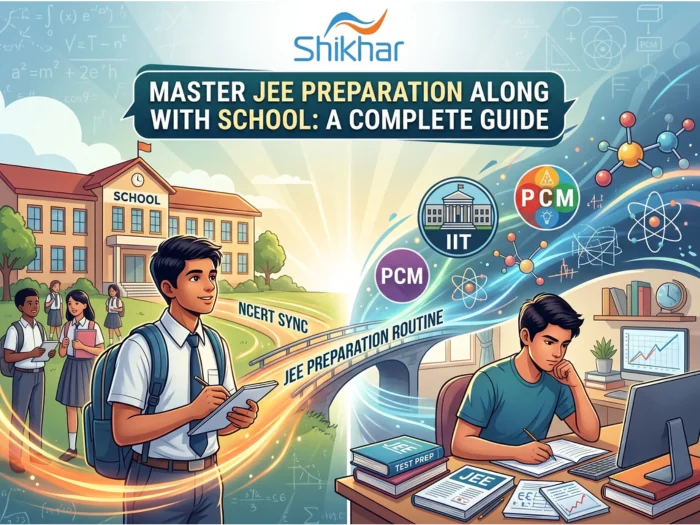
How to Master JEE Preparation Along with School: A Complete Guide for Indian Students
On an average, more than 1.2 million Indian students give the JEE Main every year and yet, a very common question among a lot of students is - Is it really possible for me to crack JEE while going to regular school?
Lack of time, board exams and non-core subjects are some of the causes of stress. But the fact is that thousands of IITians who are successful have done the same thing. With a proper plan, turning the time spent in school to your advantage rather than against you, is totally doable. This guide, based on the experiences of top rankers and coaching experts like Shikhar Classes, shows you how you can simultaneously prepare for JEE and attend school without getting exhausted.
Is It Possible to Prepare for JEE Along with Regular School?
The shortest answer is yes. You can manage school and JEE simultaneously if you change your perspective. The main thing is to stop considering school as an interruption. Instead, accept it as a scheduled part of your study plan. The following three pillars make it possible to do this.
Treat School Hours as Your Primary Study Time
It is an indisputable fact that students seldom use their school hours effectively. Physiologically it is difficult to focus one's attention for the entire duration of a lesson but a conscious effort to pay attention and active listening will make a difference. What a student misses by not paying attention in class is time wasted in trying to remember and understand the content later at home, which can be as high as 40% of study time. Using the school time to full advantage will give more time at home for more effective revision and practice.
Syllabus Synchronization - NCERT is Your Best Friend
CBSE and State board syllabus run parallel mostly with JEE syllabus. It's basically a two-for-one deal if you are preparing for the JEE objective level and simultaneously writing stepwise solutions for board exams. You can rely on the NCERT textbooks for this. In fact, many direct questions in JEE Main Chemistry come straight from NCERT.
The 6-Hour Self-Study Setup
Several toppers go for a daily 4-6 hours of focused self-study after school. Follow the 3-subject rule: do Physics, Chemistry, and Maths every day for about 1.5 hours each. That way no subject will lag and you will also be able to maintain the momentum. On top of everything else, quality study beats quantity. Studying with full concentration for 4 hours post school is better than an 8-hour distracted session.
What does this have to do with JEE with school? By folding school hours into your study schedule and sticking to a disciplined home routine, you stop doing the same things twice and get more free time for mock tests and doubt clearing, which are the big factors in JEE success.
The 80/20 Rule in JEE Focus on High-Yield Topics
The 80/20 principle says that 80% of your results come from 20% of your efforts. On the JEE preparation side of things, this means that you have to find out which chapters have the most weightage in the exam and learn them first. For example, in Physics, topics like Mechanics, Electrodynamics, and Modern Physics can account for more than 60% of the marks. In Mathematics, Calculus and Algebra represent the major portions whereas for Chemistry, Physical Chemistry and important Organic reactions are the main focus areas.
How to Apply the 80/20 Rule Along with School
The first thing you need to do is go through the distribution of marks for the last 5 years of JEE Main. After that, you will be able to organize a list where you give priority to the chapters that have a heavy weightage (for instance Thermodynamics, Rotational Motion, Coordination Compounds) as "A-category" ones. Do 80% of your self-study time in these areas. Spend the other 20% on topics of less weightage or ease. Also, take advantage of weekends and use them to work on backlogs in these high-yield areas.
How to Manage School with Coaching - A Practical Double-Load Strategy
A lot of JEE aspirants go to a separate coaching center and their regular school. This "double load" of classes - 3-4.5 hours of coaching daily plus 6-7 hours of school, might leave you exhausted if you don't follow some tips. The Reddit sub-community, r/JEENEETards, has made a 10-step guide to handle this situation practically.
Prioritization and Elimination of Low-Yield Tasks
If you have school homework, do it during school times, free periods or lunch breaks. For the non-core subjects like English, Physical Education, and the 5th subject, just reading summaries and completing the assignments right after the class is enough. Most evenings you should refrain from doing these subjects, except in the timescale leading to board exams. Switching like this can get you extra 1-2 hours for JEE problem practice every day.
Managing Non-Core Subjects Effectively
Consider non-core subjects as a method to refresh your brain from hard PCM problems. But, you shouldn't throw them out totally - give 1 hour every Sunday to complete your projects and practical files. When it's time for board exams (Jan-Feb), focus on these subjects for a full week. Otherwise for the rest of the year 90% of your time should be earmarked for PCM and JEE.
Class 11 vs Class 12 - Tailoring Your JEE Preparation Strategy
The manner in which you manage school and JEE will differ A lot from Class 11 to Class 12. These two stages are discussed below.
Class 11 Building a Strong Foundation (No Backlogs)
Class 11 is an excellent time to work on the fundamentals. You get the power to learn all JEE topics including the overflow topics from class 12, without leaving the syllabus unfinished. Round up your 11th class lessons and then do some preliminary studies for 12th.
Class 12 Balancing Boards and JEE Main
When it comes to Class 12 and your boards killing JEE plans, the key lies in efficient and smart planning. This is easiest if you have already done well in Class 11 and built the foundation for concepts that you need to apply in Class 12. When studying for JEE, you need to focus on all the minute details and fine nuances of a concept. Naturally, this understanding and the skills of writing down the solution is used in the Boards as well. So, there lies the secret - do Advanced JEE level preparation which will cover JEE Mains and Boards automatically.
Quick Glance Your Daily Checklist for JEE with School
- Morning (before school): Review 5 formulas + 2 reactions (15 minutes)
- During school hours: Active listening in PCM classes; finishing school homework in free periods
- Travel/breaks: Do 1 MCQ or memorize a short concept (micro-productivity)
- After school (4-6 hours): Spend 1.5h each on Physics, Chemistry, and Maths, 30 min for revision focus on high-weightage topics
- Weekends: One full-length mock test (Saturday); Backlog clearing and solving PYQs (Sunday)
- Non-core subjects: Only on Sunday afternoon or right before board exams
Conclusion
It is not a myth that JEE can be cracked while studying in regular school after all, this is the path of thousands of successful engineers. The formula is quite simple - incorporate school into your study plan, focus on the main topics with the help of the 80/20 rule, smartly manage your double load, and be consistent. Always remember that quality wins over quantity. With the right guidance from Shikhar Classes, your time at school can be a stepping-stone rather than a challenge. Don't delay. Begin now and see your JEE rank soar without giving up your regular school life.
FAQ Section
Q1: Is 40,000 a good rank in JEE? Can I get an NIT with it?
Your rank of 40,000 in JEE is pretty good overall. While getting into an old IIT with such a rank would be impossible ( the required rank is barely under 10,000), you can definitely get admission into good NITs, IIITs and GFTIs, for sure in branches like Civil, Metallurgy or Production Engineering. If we talk about JEE Advanced, 40000 is a rank where a student qualifies but it is highly unlikely that he or she will be getting a core branch in top IITs. For your category, you can always check the opening and closing ranks of last year.
Q2: Where can I find authentic Hindi resources for JEE preparation?
There are lots of youtube channels like eSaral, Competishun, and PW (Physics Wallah) providing full JEE courses in Hindi. You may also search "How to prepare for JEE and school in Hindi" on Google for blogs and Hindi PDFs. Further, Shikhar Classes offers bi-lingual study material for Hindi-medium students.
Q3: Is it possible to manage JEE with regular school if I don't attend a dummy school?
It's not only possible, it's the subject of this very article. With the help of above-mentioned strategies - treat school as study time, synchronise syllabus, and follow the 6-hour rule - you too can become one amongst the thousands of students who have succeeded in JEE while studying in regular CBSE/State board schools without even going to dummy school. What you require is proper discipline and intelligent time management.
Q4: How do I clear backlogs while attending school daily?
"weekend backlog clearance" method is the most effective one. First, pen down all the chapters you have left unfinished. Then, dedicate 3-4 hours to one backlog subject every Saturday. Do not go on trying to cover everything at the same time. Start with one chapter, watch a concept video, solve 20 questions and put a tick against it as done. Also, make use of your school's library periods for revising old notes. In case there is too much backlog, you should think about joining a weekend doubt clearing session at a coaching centre like Shikhar Classes.