IIT Preparation for Class 8: Is Starting Early Worth It for Indian Students?
Published on July 11, 2026 by Parul Sharan
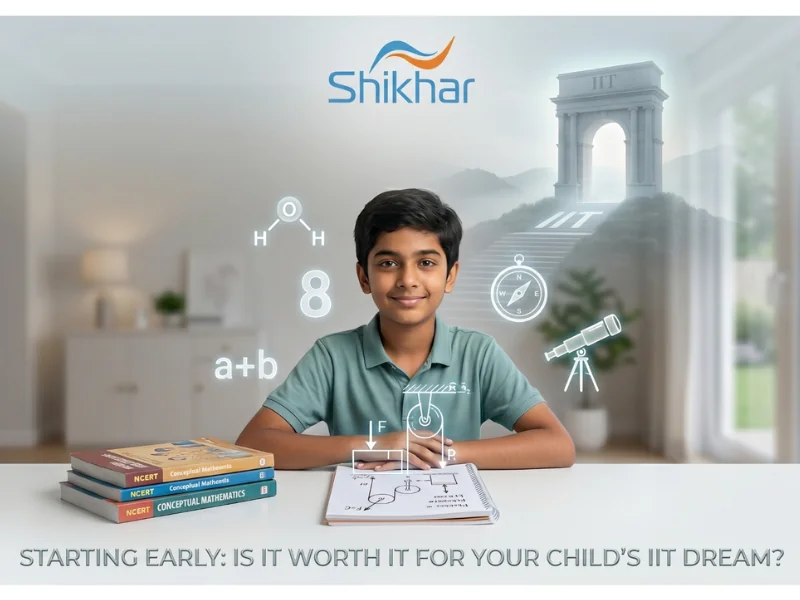
IIT Preparation for Class 8: Is Starting Early Worth It for Indian Students?
Many Indian students and their parents dream of cracking IIT-JEE not in Class 11 but much earlier. The pressure to get into a top IIT has resulted in the trend of starting a foundational IIT preparation as early as middle school.
Starting IIT preparation for class 8 may not only be a question of whether it will work for a student but also if it will be a cause for mental breakdown. This article outlines pros and cons for early starters, serving as a complete guide for young aspirants and their families.
What Makes IIT Preparation from Class 8 Worth It?
Most parents wonder if it is really worthwhile to start the preparation at the age of 12 or 13. Expert opinions and community feedback suggest a balanced, conceptual approach rather than focusing on the examination itself.
An early start is First and foremost advantageous with gaining a strong foothold in Physics, Chemistry, and Mathematics without the simultaneous pressure of board exams or the competitive atmosphere of Class 12.
Can I start IIT preparation from class 8?
Class 8 is the right time to start the preparation. It is not about facing JEE Advanced problems at this stage but ensuring a firm understanding of concepts, strengthening logical thinking, and developing a problem-solving attitude. Students should keep their preparation in sync with the school syllabus, taking NCERT textbooks as a starting point.
The focus should be on understanding "why" and "how" rather than memorizing. For instance, a Class 8 student should not just be solving linear equations but finding their practical applications in physics. Building such a strong foundation gives students less "shock" when confronted with JEE-level problems starting Class 11.
How to start JEE preparation from Class 8 at home?
Studying at home is an easy and comfortable way to begin.
- Firstly, establish a tidy studying place and a doable weekly schedule that accommodates 1-2 hours of disciplined self-study daily besides studying at school.
- Secondly, make use of free learning material such as NCERT textbooks, and the YouTube channels that teach science and math concepts visually.
- Thirdly, work on Olympiad problem books or riddles to enhance analytical thinking.
Also, write down mini-goals for every week like completing one chapter from RD Sharma Mathematics. Timing yourself can be done later, currently, the focus is on understanding thoroughly. The self-control developed during Class 8 is the foundation laid for the serious phase of jee preparation ahead. For systematic help, online courses like Shikhar Classes, which offer live group classes tailored for that age group, are suitable.
Key Advantages of Starting IIT-JEE Preparation Early (Class 8)
Entering the JEE journey as early as Class 8 opens up numerous lasting advantages that are not limited to mere extra time for studies.
It changes how a student thinks about learning and solving problems.
- More Syllabus Time: The JEE syllabus is extremely extensive as it mainly consists of Classes 11 and 12 materials. Early initiation makes it possible to slowly get acquainted with topics like basic calculus and advanced mechanics over 3-4 years, thus greatly reducing the stress during the last-minute revision phase.
- Less Hardcore Study Stress from Class 11: Many extremely smart students face a hard time in Class 11 as JEE-level questioning comes as a big change to the normal school-level questions. Those who have started early keep on advancing their level gradually to the point that the final jump could even be quite a thrilling experience for them. By Class 11, they would have solved multi-concept problems quite comfortably.
- Early Discovery of Talent: Students who start in Class 8 will, by Class 9, have a clear idea as to whether they are really interested in STEM or they are just doing it to please the parents. Achieving this milestone of awareness can be a great help in avoiding unnecessary time loss and emotional wounds by guiding the students in the right direction.
Potential Drawbacks and How to Avoid Them
While early preparation comes with several advantages, neglecting the disadvantages may result in burnout, anxiety, and a lack of childhood experiences to the extent of being harmful to the student's well-being. A balanced viewpoint thus becomes indispensable.
- Burnout and Mental Stress: Keeping a 13-year-old’s brain occupied for many hours without proper breaks can bring fatigue, loss of interest, and even depression. To escape such a downfall, make it a point to have one full day per week without any study. Besides studies, let the students engage in hobbies, sports, and socializing.
- Missing Out on Childhood: The aggressive coaching schedule is a common reason for many JEE aspirants’ regret regarding not being able to celebrate their birthdays, go for family outings, or even attend school events. Giving an example of the classic "How to avoid it" situation, this can be done by keeping formal coaching time to 4-6 hours per week. School extracurriculars and friendships should be prioritized. The aim here is adding JEE preparation to a healthy life and not overburdening one's life by JEE preparation.
Essential Books and Resources for Class 8 JEE Aspirants
Using the appropriate books at the proper age is half the battle won. These are the recommended resources.
- NCERT Textbooks (Classes 8, 9, and 10): Begin from here. Master every notion, example, and exercise in your school NCERTs. No JEE preparation can be considered complete without the clarity brought by NCERT. These books lay down the formal groundwork under the Indian education system.
- RD Sharma Mathematics (Class 8): This is the absolute reference for improving the ability to solve problems and understanding ideas in-depth for Mathematics. Firstly, present very basic problems and progressively make them more difficult. Great for an 8th grader.
- Lakhmir Singh & Manjit Kaur Science (Physics, Chemistry, Biology): They are famous for clear explanations with examples, illustrations given well. Apart from covering what is in the NCERT, they give a very good basis for what happens in the JEE. At Class 8, have a good look at Force & Pressure and Chemical Reactions.
- Pearson IIT Foundation Series (Class 8): This is the first "real" JEE foundation book. It introduces concepts in a slightly more advanced way and includes problems that require analytical thinking. Use this only after you are confident with NCERT and Lakhmir Singh.
Why Shikhar Classes is the Right Partner for Early IIT Preparation
Many parents who want to get their children started at an early stage are often not sure where to take them. Shikhar Classes, as a dedicated outfit that caters to the needs of Indian young aspirants, is quite a different league from typical online platforms which tend to dupe learners into rote learning.
Here, conceptual clarity is built through live interactive small-group classes. The JEE foundation program for Class 8 at Shikhar Classes is designed to be in harmony with the school syllabi but would also encourage JEE level thinking. They provide free demo classes, use a teaching style that is keeping students engaged, and have parent-teacher meetings regularly not only to track academic progress but also ensure mental well-being.
Quick Checklist: Is Your Child Ready for Early IIT Prep?
Before planning the next five years of your child's educational growth, make sure they are in a position to handle early IIT preparation effectively and healthily by running through this checklist:
- Genuine Interest: Does your child pick up science or math puzzle books on his own? Do they constantly ask "why" questions about how things work?
- Strong School Foundation: Are their result marks above 80% in Class 8 Maths and Science without any extra tuition? In case not, focus on school classwork.
- Stress-Free Schedule: Is there still time for play, hobbies, & 8-9 hours of sleep? If JEE prepping leads to a lack of sleep, then it’s not worth it at this stage.
Conclusion
Choosing to prepare for IIT from Class 8 neither instantly guarantees success nor leads one into a perilous trap - it is rather a well-planned decision that needs intelligence, harmony, and the correct network of help. A solid base, lower anxiety at the later stage, and recognizing one's talent early are some of the great advantages, but these benefits will be useful only if one stays away from the dangers of overwork and the deprivation of a childlike spirit.
Make use of the suggested books, exploit the availability of free online resources, heed the counsel of the community, and enroll in a well-balanced foundation course such as the one run by Shikhar Classes that focuses on understanding rather than rote learning. Starting in Class 8 will be your first confident step towards IIT and to a lifelong enthusiasm for learning if you use the right method.
FAQ Section
Q1: Can a 14-year-old give the JEE exam?
Generally, no. You must be at least 17 years old to be eligible for the JEE Main examination. Yet, a 14-year-old student can participate in the National Standard Examination (NSE) or other science Olympiads to assess their basic knowledge and get the experience of an examination. These Olympiads are great ways of boosting confidence and they do not have a minimum age limit.
Q2: Is JEE preparation from Class 9 too late?
Definitely not. Starting Class 9 is the perfect situation and still early. You will have a couple of years before Class 11 to prepare yourself thoroughly. The only difference is that a student who starts in Class 8 will have a little more time for multiple revisions. Yet, a dedicated Class 9 student can entirely catch up by sticking to a strict time-table. The standard and quality of the study matter more than the time when you start.
Q3: Is JEE Shift 2 harder than Shift 1?
In general, a student might find one shift tougher than the other; Though, through normalization (percentile system), NTA makes sure that the students are treated equally across shifts with difficulty and through these adjustments, the students' rankings are also reflective of the equivalent difficulty. But as a Class 8 student, you should concentrate on your concepts instead of worrying about which shift was harder.
Q4: What is the ideal daily study time for a Class 8 IIT aspirant?
Ideally, 1 to 2 hours of focused self-study apart from school homework should be enough. This can include solving 5-10 math questions, going through one science topic in detail, and revising the lessons taught in the school. One should try to avoid studying more than 3 hours daily at this age. Maintaining a regular study routine matters more than long hours. Also, one should not forget to spend some time on sports, hobbies, and family.
Q5: How can Shikhar Classes help my child in Class 8?
The Class 8 students who are JEE aspirants get a great help from Shikhar Classes through their special JEE foundation course, which is based on conceptual learning via live, online classes. Their batch sizes are small to ensure each student gets the necessary attention. The students are involved in the teaching-learning process that does not overwhelm them, and the classes are simple enough for the young learners. They also monitor their students' progress regularly and conduct mental well-being sessions, thereby ending up as trustworthy partners in the early preparations for IIT. Please visit their website to book a free trial session.