Competitive Exams After 12th: Your Complete 2027 Guide to Career Success
Published on July 10, 2026 by Parul Sharan
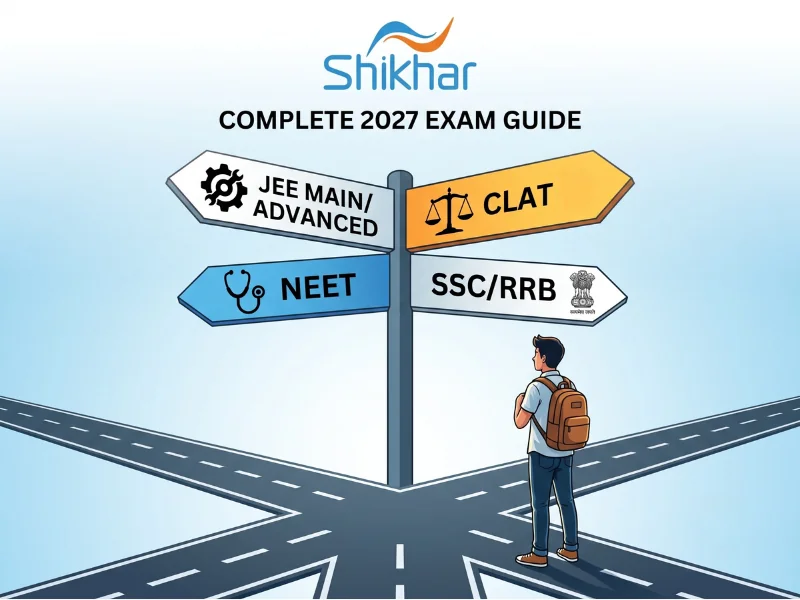
Competitive Exams After 12th: Your Complete 2027 Guide to Career Success
Every year more than 1.2 crore students appear for the 12th board exams in India and very few among them are aware that the ones who succeed will have to face some big challenges. Once you complete your 12th board exams the decisions you take regarding your next steps i.e, which college, which course, and which competitive exam to prepare for can be life-changing.
Along with limited seats in the top-notch institutions like IITs, AIIMS, and NITs, the government sector also has thousands of vacancies, and so, knowing the competitive exams after 12th is simply not an option, it is a necessity. In this article, we are going to introduce all the major entrance and job recruitment exams to prepare you for a successful future.
What Are the Top Competitive Exams After 12th for College & Jobs?
The "best" exam actually means the "best" for you depending on your career goal. For example, if you want to be an engineer, then JEE is the exam you should take. Those who want to be doctors should go for NEET. Those who are interested in getting a government job can prepare for the SSC and RRB exams. Here is a list of the most well-known undergraduate entrance and recruitment exams in India, divided by streams for easier understanding.
JEE Main/Advanced & NEET for Traditional Careers
Science students with PCM (Physics Chemistry Math) have the Joint Entrance Examination (JEE) Main and Advanced which open doors to the Indian Institutes of Technology (IITs), National Institutes of Technology (NITs), and other centrally funded technical institutes. Students are required to prepare for these exams round the year. For the PCB (Physics Chemistry Biology) students, National Eligibility cum Entrance Test (NEET) is the only mode of admission to MBBS, BDS and AYUSH courses in India. The competition is so fierce for these exams that the percentage of success is less than 2% almost always.
CLAT, NDA, and CUET for Diverse Pathways
Not all students are interested in engineering and medicine. Those who want to be lawyers have the option of Common Law Admission Test (CLAT) through which they can get admission to any of the 22 National Law Universities (NLUs) for integrated BA-LLB or BBA-LLB programs.
If you are a defence aspirant, then you should appear for the NDA (National Defence Academy) exam conducted by UPSC which gives 12th pass students the opportunity to join the Army, Navy or Air Force. In addition, CUET (Common University Entrance Test) has been made compulsory for most central universities like Delhi University, BHU, and JNU, which offer hundreds of undergraduate courses in humanities, commerce, and sciences.
SSC, RRB, and State Exams for Direct Employment
There are some government exams which can be directly sought after by students who have passed 12th for getting a job without higher education. Staff Selection Commission (SSC) conducts CHSL (Combined Higher Secondary Level) recruitment for clerical posts and MTS (Multi-Tasking Staff) for non-technical roles.
Along the same lines the Railway Recruitment Board (RRB) organizes exams for NTPC (Non-Technical Popular Categories) and Group D comprising posts, and provide employment with a good pay scale approximately ranging from Rs.21,700 to Rs.58,000. Also a number of state governments conduct police constable and forest guard exams for 12th-pass candidates.
This extensive range of exams indicates that whatever your background be, there is a competitive test customized to your ambition.
List of Competitive Exams After 12th for Engineering
Even though JEE Main is the most well-known engineering entrance examination it is not the only one. Every year about 15 lakh students appear for JEE but only a small percentage manages to get a seat in IIT or NIT. Luckily, for engineering aspirants, apart from JEE there are several other recognized entrances that lead to the best engineering colleges.
Top Engineering Entrances Beyond JEE
- BITSAT (Birla Institute of Technology and Science Admission Test): It is conducted by BITS Pilani for admission to its campuses at Pilani, Goa, and Hyderabad. It is an online test and is regarded as a great alternative to IIT.
- VITEEE (Vellore Institute of Technology Engineering Entrance Exam): It is conducted for the admission in VIT's campuses namely: Vellore Chennai Bhopal, and Amaravati. 2 lakh students apply for approx. 5,000 seats in this examination every year.
- SRMJEEE (SRM Joint Engineering Entrance Examination): SRM Institute of Science and Technology holds this test for admission in engineering at Kattankulathur, Ramapuram, and other campuses.
- State-Level Exams: Most states also conduct their own engineering tests which are MHT CET (Maharashtra), KCET (Karnataka), AP EAPCET (Andhra Pradesh), and WBJEE (West Bengal) as some examples. These are quite less competitive compared to JEE but provide great local colleges.
Government Competitive Exams After 12th Science
Many science students end up choosing job security over further studies. However, immediate jumps into government sector jobs are possible even for 12th-pass science candidates through the government recruitment system.
SSC Exams for 12th Pass (CHSL MTS GD)
SSC is the biggest recruiter for 12th pass students. SSC CHSL exam recruits for clerical positions in the central government offices whereas SSC MTS is for supporting staff like peon, guard, and office attendant. Students interested in physical tasks can opt for SSC GD Constable that recruits personnel for BSF CISF CRPF, and SSB. The application fee is very minimal (Rs.100 for general category and free for SC/ST) making these exams accessible to one and all.
Railway and Defence Opportunities (RRB NTPC, Group D, NDA)
Railways are considered as the backbone of government employment. RRB NTPC exam is conducted for recruitment of commercial apprentice, clerk, and timekeeper posts and RRB Group D covers track maintainers and helpers. Among the defence-oriented science students, the NDA exam (mentioned above) remains the most prestigious one. Besides that, female science students can also join the Indian Army through the Agnipath scheme after 12th, or apply for paramedical roles in the armed forces.
Government Competitive Exams After 12th Biology
PCB students generally think that NEET is their only way to a medical college. However, the reality is that there are quite a few government level exams for medical and life science students that lead to success in excellent research and agriculture careers.
Beyond MBBS: ICAR, NEST, and Other PCB Exams
- ICAR AIEEA-UG-PG: It is an examination conducted by Indian Council of Agricultural Research for admission to B.Sc. Agriculture, Horticulture, and Forestry courses in state agricultural universities. A government agriculture degree opens a door to various public sector and banking jobs.
- NEST (National Entrance Screening Test): It is the admission test for five-year integrated MSc programs at National Institute of Science Education and Research (NISER) and Department of Atomic Energy Centre for Excellence in Basic Sciences, University of Mumbai. It is a key gateway to research careers.
- B.Sc. Nursing Entrance Exams: AIIMS, JIPMER, and different state governments conduct separate exams for B.Sc. Nursing courses which lead directly to government nurse positions in hospitals and hence come with good job security.
Which Is the Toughest Exam After 12th?
Since the term "tough" is relative, we have ranked the subject-wise difficulties and the number of competitors for certain exams in India, which helps to interpret the preparation periods accordingly.
Ranking India's Most Challenging Undergraduate Entrances
- IIT-JEE Advanced: This is undoubtedly the toughest one. It has a success rate of less than 1%, (about 40,000 seats for over 15 lakh initial applicants), demands knowledge of three subjects and has an element of time constraint in problem-solving scenarios.
- NEET: With more than 2 million students vying for around 160,000 MBBS seats, the absolute competition, and the cut-off marks (usually 600+ out of 720 for the general category) make it extremely challenging.
- CLAT: Because the syllabus is limited, the speed at which you have to do logical reasoning and comprehension under two hours gives it a high difficulty rating.
- NDA: There is a written test that is then followed by a 5-day SSB interview, which only about 5% of candidates pass. It is known to be testing not only knowledge but also personality.
Such exams require not only hard work but smart work, including taking up regular mock tests and consistent revision of concepts.
Quick Glance at Your Post-12th Competitive Exam Roadmap
Before you start, here is a checklist to help you keep your preparation on the right path:
- Stream Identification: Make sure you know if you are PCM, PCB Commerce or Arts.
- Goal Decision: Do you want "College Admission" (JEE NEET CLAT, CUET) or "Direct Job" (SSC RRB State exams).
- Exam Calendar Check: SSC exams are usually in March-June, JEE in April/May, NEET in May. Always avoid overlapping two heavy syllabus exams.
- Eligibility Confirmation: Also make sure your age fulfills the criteria (e.g. NDA is between 16.5-19.5 years) and a minimum percentage is met (most exams require 50-60% in 12th).
- Resource Collection: You need to have the latest syllabus, the previous 5 years' papers, and a single, reliable coaching institute like Shikhar Classes to avoid confusion and tangled paths in your preparation.
Conclusion
Life after 12th boards is less about luck and more about making wise choices. Whether you plan to crack the IITs, get a government job in railways, or do a research career through NEST, a competitive exam is waiting for you. The one thing you have to do is select one, understand its pattern, and prepare regularly without mixing up your goals.
Anytime you get stuck on the comprehensive syllabus or quantitative aptitude problem-solving sections, do take help from Shikhar Classes, which provides scheduled online and offline batches. This way you will meet your daily targets and break down these exams to be less intimidating. With proper guidance and a clear pathway, passing a competitive exams after 12th is indeed a very attainable objective.
Frequently Asked Questions (FAQ)
Q1: Which exam is best for girls after 12th?
There are no such "best" exams that are available only to girls. However, some government examinations provide girl candidates with certain benefits. For instance, the Indian Army's Agnipath scheme and paramilitary forces (BSF, CRPF) have separate women constable vacancies. Moreover, due to the fixed working hours and safe work environment, teaching eligibility tests (TET) and banking exams (IBPS Clerk) generally have a very high success rate among women. SSC CHSL is also a popular choice.
Q2: Can I prepare for competitive exams after 12th without coaching?
Yes, it is absolutely possible to do well in examinations such as SSC MTS or state police through free resources on YouTube and online practice platforms. However, if it is the JEE or NEET then preparation is suggested to be done with experienced institutes like Shikhar Classes, Allen etc. that have their own discipline, test series, and doubt-clearing sessions which are hard to do individually.
Q3: When do the major competitive exams generally take place?
Most of the exams are held on a yearly basis. JEE Main is conducted in two sessions - January and April. NEET is held in May. CUET is usually around May-June. SSC CHSL notifications are out in February-March, and exams start from July onwards. RRB NTPC cycles are different, but usually begin in the last quarter of the year.
Q4: What is the registration fee for government competitive exams?
The fee for unreserved (General/OBC) candidates is anywhere between Rs.100 and Rs.1500. For instance, SSC CHSL is priced at Rs.100. Most SC/ST/Physically Handicapped (PwD) candidates do not have to pay the fees. In fact, female candidates are frequently given fee waivers in state-level examinations.