Classroom vs Online Learning: What Works Best for Competitive Exam Preparation?
Published on August 27, 2026 by Chetna singh
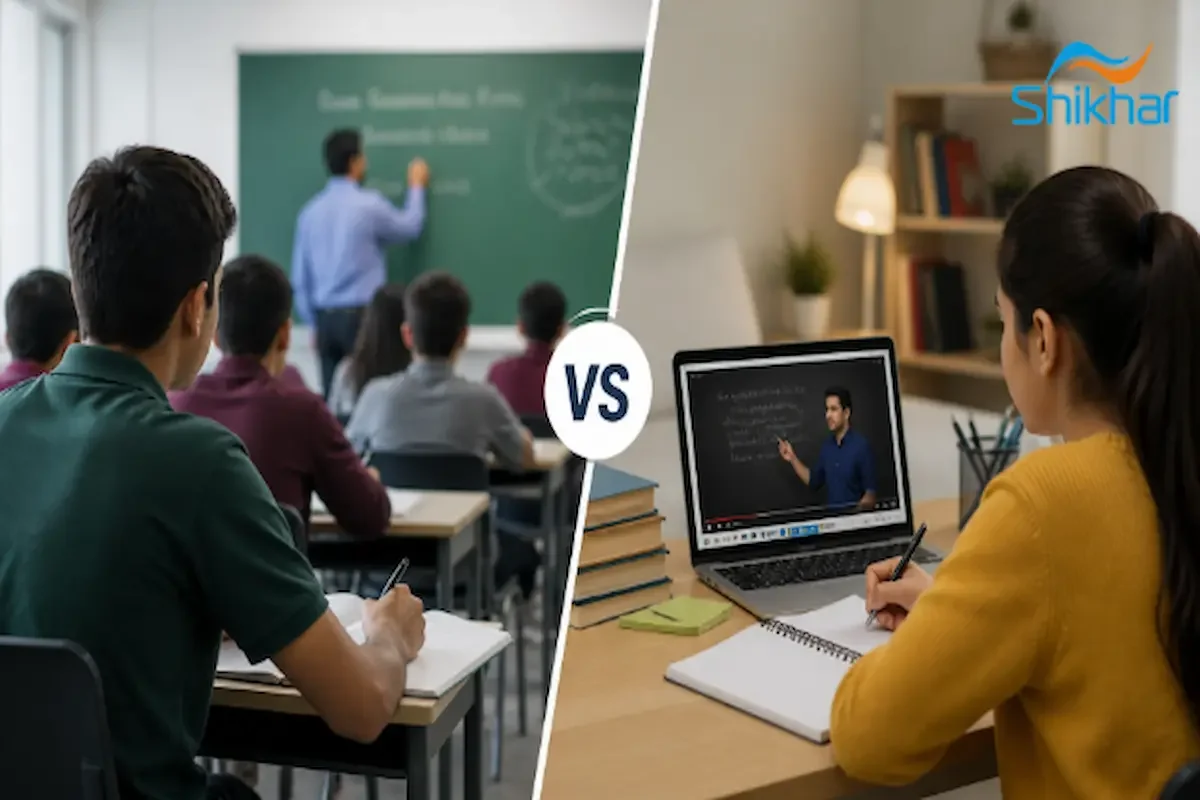
Classroom vs Online Learning: What Works Best for Competitive Exam Preparation?
Millions of Indian students annually come across an important dilemma—should they go for a physical classroom coaching institute or rely on online learning platforms? It becomes a big decision for students who appear for competitive exams like NEET, as the gap between success and failure is so minimal that even the slightest deviation from a well-prepared, self-dedicated study plan can change one's destiny. At Shikhar Classes, we understand this critical choice and help students navigate it with expert guidance.
Ultimately, the wisest choice is for students to select the mode of learning that best aligns with their personal learning style, discipline level, and individual academic needs.
What is the Difference Between Online Learning and Classroom Learning?
The table below shows the major differences that affect a student's decision while preparing for competitive exams:
What is Classroom Learning?
Classroom learning sets you on a clear path through the entire syllabus with regular assessments, test series, and dedicated sessions for clearing doubts. The presence of an actual teacher physically brings in an emotional component of education that even a pre-recorded video cannot reproduce. Students in live classes have a higher attention span than those learning through videos at home. This is why choosing the right coaching institute is so crucial for competitive exam success.
Benefits of Classroom Learning
The advantages of classroom learning go beyond textbooks and blackboards, directly impacting better results in competitive exams through a classroom setting. A physical classroom, besides covering the entire syllabus, trains learners to be disciplined, focused, and resilient so they can perform under pressure.
What are 10 Reasons Why Classroom Learning is Better than Online Learning?
1. Structured Environment: A regular classroom provides daily fixed timings that allow students to build their routine. Self-managing in online learning is challenging, as many students find it difficult to keep their schedule consistent without external structure.
2. Direct Teacher Interaction: During the lecture, any doubt can be raised and resolved right away. In virtual classrooms, clarifying things is not immediate, which can lead to the development of misconceptions. This is especially critical for subjects covered in NEET preparation.
3. Peer Learning and Competition: The presence of peers is motivating as it creates a competitive atmosphere that pushes students to outperform. They get encouraged to make more effort after observing others getting the answers correct.
4. Discipline and Accountability: Because students are physically present and attendance is actively tracked, their preparation remains closely supervised, keeping them accountable for their daily performance. While skipping online classes is easy, offline students can rarely miss sessions without teachers and parents noticing.
5. Immediate Doubt Resolution: Doubts cleared in the classroom prevent confusion from extending to other topics. This is one of the key benefits of classroom coaching that online platforms struggle to replicate.
6. Practical Demonstrations: Physics and Chemistry often require practical demonstrations and a hands-on grasp of theoretical concepts. Students understand these topics far more effectively when a teacher conducts a live, in-person demonstration.
7. Reduced Distractions: A physical classroom removes common home distractions, such as social media, TV, and family conversations, allowing students to focus their entire attention on understanding the lecture.
8. Group Discussions: Classroom debates and group study sessions give students an opportunity to see problems through various angles, increasing the depth of understanding far more than learning the same topic alone would.
9. Motivation through Live Energy: The liveliness and excitement of the teacher help students concentrate throughout the lesson. With online lectures, most students are just watching and are unlikely to memorize what was said.
10. Mentorship Beyond Syllabus: Classroom teachers give students advice and skills for time management, handling pressure, and study strategies. There is no way for students to get this kind of guidance from just watching a class recording.
Classroom Learning Environment
A classroom is more than just a room with a board—it is an ecosystem built for learning. The physical presence of a teacher, their tone of voice, body language, and the collective energy of the students all create an atmosphere that is difficult to replicate online. For NEET aspirants, being surrounded by peers working toward the exact same goal naturally reinforces discipline, focus, and drive.
This environment also fuels healthy peer competition. Watching a classmate crack a complex Physics numerical sparks an immediate urge to level up. Furthermore, group doubt sessions and timed in-class tests recreate real exam pressure, training students to develop the temperament needed for test day. This shared energy and mutual push are precisely why traditional coaching hubs across India continue to thrive alongside digital platforms.
Are Coaching Classes Necessary for NEET?
Coaching classes are not strictly mandatory to clear NEET, but they provide a level of structure and guidance that most students struggle to build on their own. Because NEET is a highly selective medical entrance examination, following an organized, well-planned, and systematic preparation strategy is what truly helps an aspirant stand out and succeed.
A good classroom coaching institute prepares students to handle the entire curriculum alongside frequent testing and doubt-clearing sessions. A disciplined classroom setting can be a great blessing for students who struggle to build an independent study routine.
Virtual coaching covers the same lessons, but it relies heavily on sustained self-motivation. In a physical classroom, students are held accountable by teachers for their attendance, class participation, and regular doubt resolution. This natural system of accountability, combined with positive peer energy, motivates students to study consistently.
This is the very concept on which the NEET program at Shikhar Classes works, integrating classroom coaching with continuous test series and personal mentoring to keep students on their toes.
Can We Clear NEET with Regular School?
It is entirely possible for a student to clear NEET while attending regular school. However, this requires exceptional time management and strict self-discipline. While school helps build fundamental concepts, preparing for medical entrance exams demands significantly more depth, time, and practice. Managing board exam preparation and school assignments is often the biggest hurdle, making it difficult to allocate dedicated time for NEET revision.
Consequently, many students enrolled in standard coaching programs struggle to balance both demands. To solve this, specialized integrated classroom courses are designed to complement the school curriculum, covering the full NEET syllabus while aligning smoothly with school schedules.
Shikhar Classes has also kept school timings in mind while organizing their course schedule. This enables students to be both regular school attendees and NEET aspirants at the same time without any loss.
Final Checklist: Choosing Between Classroom and Online Learning
- Assess your self-discipline: If external support is what keeps you going, opting for classroom learning would be more convenient for you.
- Consider doubt-solving needs: The best way for doubts to be cleared is through discussions or one-on-one face-to-face interaction, and these are the features one gets through attending classroom sessions.
- Evaluate peer factor: Healthy rivalry in classrooms will drive you to do well more often.
- Think about the exam goal: Those who prefer a hands-on approach would like to be in a classroom environment, while self-learner types might prefer online courses. For high-stakes exams like NEET, the structure of classroom learning offers a clear advantage.
- Check your house environment: If home is full of distractions, a classroom provides a dedicated study space. With the most important exam NEET, the classroom learning structure offers tremendous help.
A classroom is by no means the only option for learning, as it also depends on students' characteristics like their learning styles, self-discipline levels, and motivation levels, which will result in different learning situations for different students.
However, for medical entrance exams like NEET, the structure, discipline, and mentorship of classroom learning give students a significant edge over purely online preparation. This is why students consistently choose offline coaching for their competitive exam journey.
Shikhar Classes offers a classroom setting created specifically to help NEET candidates with experienced faculty, frequent assessments, and personal mentoring. Students can focus entirely on NEET and achieve their desired goal of a medical degree.
Frequently Asked Questions
Q1: Which class is best to start NEET preparation?
The general consensus among NEET preparation specialists is that Class 11 is the ideal time to begin serious, full-fledged preparation, as the school board and NEET syllabus are virtually identical at this level. Although having a basic foundation in these subjects as early as Classes 8, 9, or 10 is undeniably helpful, dedicated and intensive NEET coaching should ideally commence in Grade 11 rather than earlier.
Q2: What are the advantages of online learning?
Online learning platforms offer students several advantages, including flexible study hours, access to expert educators from across the country, and the ability to rewatch recorded lectures at their own pace. Furthermore, eliminating travel and accommodation expenses makes it possible for students in remote areas to access high-quality education.
Q3: How to balance school and NEET preparation?
You can use your school hours mostly to cover the school curriculum, as this time is already allocated by the school. For the rest of the time, focus on NEET-oriented coaching. To manage this efficiently, your daily schedule must clearly indicate not only when school projects need to be done, but also when coaching sessions and self-study hours are scheduled.
Q4: Is online or offline coaching better for NEET?
Generally, offline coaching is considered highly beneficial for students who need guidance, supervision, and encouragement. Offline teaching helps provide that kind of environment and direct contact with teachers. In contrast, online classes may suit a self-driven learner who can focus without outside distractions. But again, it's not surprising to find that almost all students do better when they have the regular presence of their teachers, the classroom atmosphere, interaction with friends, and healthy peer pressure—in a word, the "physical environment."